

5 Districts Every Fantasy City Map Needs (and 2 I Forget)
After mapping 15 cities across 3 campaigns, I always start with the same 5 districts. The 2 I forget — undercity and tent slums — end up mattering most.
Fifteen cities. Three campaigns. Eight years of DMing across 4 different groups.
Every single time I build a fantasy city map, I start with the same 5 districts. Not because I'm lazy — because they work. They cover the 5 functions every city needs to serve in a tabletop RPG: commerce, power, faith, grime, and arrival.
And every single time, I forget to include 2 districts that end up being the ones my players care about most. We'll get to those.
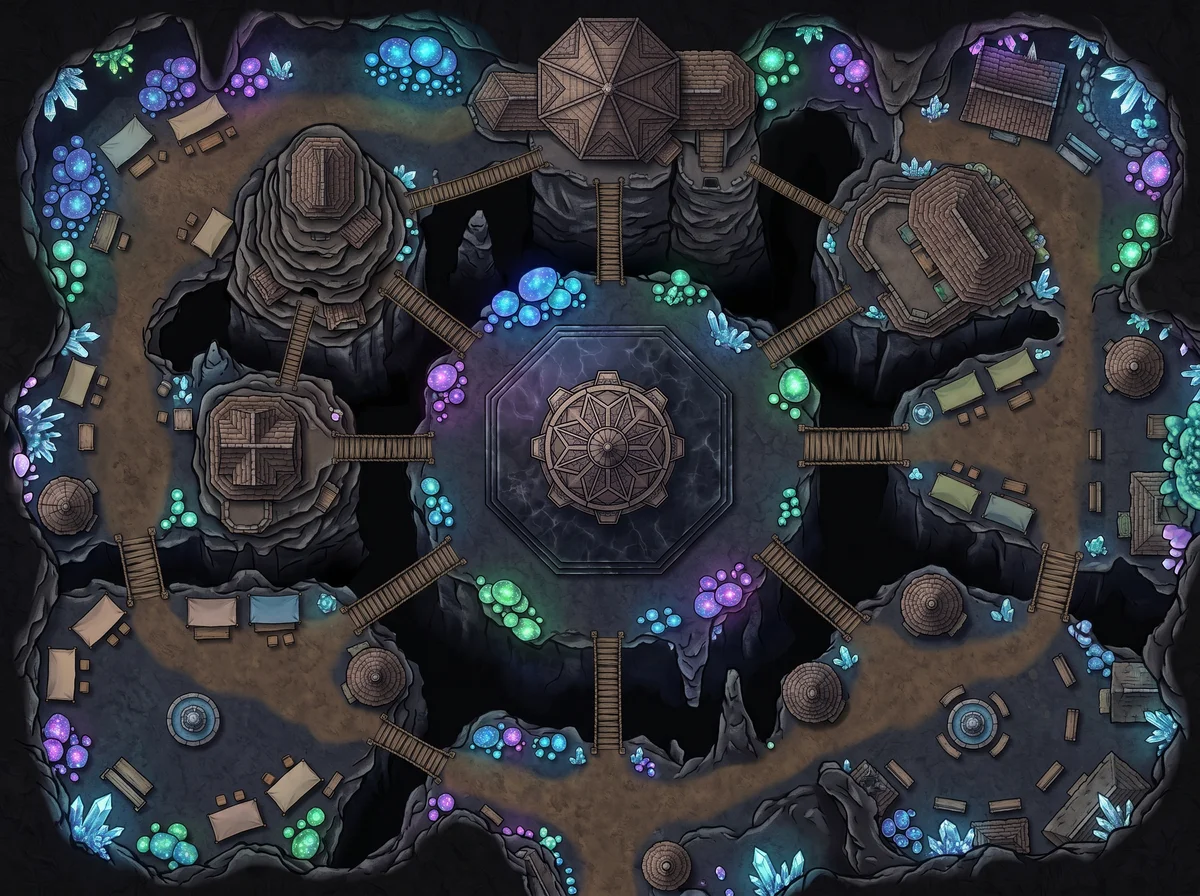
District 1: The Market Quarter
Function: Commerce. Where players buy gear, sell loot, gather rumors, and make contacts.
Every fantasy city map needs a commercial heart. In Driftholm — the port city that took over 12 sessions of my campaign — the market quarter is called Saltmere, and it's where 60% of player interactions happen. Not combat. Not exploration. Shopping, negotiating, and eavesdropping.
What to include on the map: guild halls, a central market square or bazaar, taverns (plural — at least 2, one respectable and one shady), a general goods store, a money changer.
The prompt I use: When I generate a fantasy city map with the city map generator, I describe the market quarter first because it anchors the rest of the layout. "Large open market square surrounded by two-story merchant buildings, covered bazaar stalls, a prominent guild hall."
The secret I plant: The market always has an information economy. Someone in the bazaar sells rumors, not goods. In Driftholm, it was a spice merchant who traded gossip about ship manifests. Jess's rogue spent 3 sessions cultivating that NPC.
District 2: The Seat of Power
Function: Governance and authority. Where the ruler lives, where laws are enforced, where political quests originate.
This is the castle, the palace, the governor's mansion, the council hall. In Ashenvale — the declining empire capital I built for the Shattered Coast — the Seat of Power is a crumbling hilltop palace surrounded by overgrown gardens and patrolled by guards who are mostly for show. The decline is the story.
What to include: the ruler's residence, a garrison or guard barracks, a courthouse or tribunal, a prison. Bonus: a council chamber where factions argue.
The secret I plant: the power structure is never what it seems. In Kethranor, the theocratic capital, the high priest officially rules — but the real power is the head librarian who controls which religious texts are "approved." Dan's wizard uncovered that 8 sessions in and it changed the entire political landscape.
Map design tip: put the Seat of Power on high ground. Literally. Players instinctively associate elevation with authority. Mike Shea's guide to building fantastic locations emphasizes that a location's physical traits should telegraph its narrative role — and nothing telegraphs "power" like a hilltop castle. When the city map generator produces a city with elevated terrain, my players immediately ask who lives up there. Elevation does the NPC introduction for you.
District 3: The Temple District
Function: Faith, healing, and moral complexity. Where clerics operate, where the dead are honored, where religious tension lives.
The temple district is often the most visually distinctive part of a fantasy city map. Grand architecture, open plazas, ceremonial spaces. In Kethranor, where arcane magic is forbidden, the temple district IS the city — every building serves the faith, and the streets are lined with shrines.
What to include: a central temple or cathedral, a graveyard or ossuary, a healer's chapel, shrines to minor deities. In polytheistic settings, competing temples create automatic faction tension.
The secret I plant: religious institutions hoard secrets. The Kethranor temples sit on top of sealed arcane libraries — the very magic they publicly condemn. The plague that hit the Shattered Coast 15 years ago? Arcane in origin, covered up by the priesthood. That secret has been a slow-burn thread across 20+ sessions.
When to skip it: small towns and villages don't need a temple district. A single shrine is enough. This district earns its place in cities where religion is a political force, not just a healing mechanic. The D&D Beyond sourcebooks treat temples primarily as healing stations — but at the table, they're political powder kegs.
District 4: The Docks / Trade Gate
Function: Arrival, departure, and the outside world. Where goods, people, and trouble enter the city.
Coastal cities get docks. Inland cities get a trade gate, a caravan yard, or a river port. Either way, this district is the city's connection to everything beyond its walls.
The Docks in Driftholm became the most important location in my campaign because smuggling happens at the edges. Contraband doesn't flow through the market square — it flows through the place where cargo moves at night, where customs officials take bribes, and where ship manifests don't match reality.
What to include: wharfs or a gate complex, warehouses, a customs house, cheap lodging for travelers, a shipyard or stable yard.
The prompt I use: "Docks district with multiple ship berths, warehouses lining the waterfront, a customs house at the main pier, narrow alleys between buildings." The city map generator consistently produces maps where the Docks feel like a working neighborhood rather than a decorative waterfront.
The secret I plant: something illegal is always happening at the docks. Always. It's the most narratively productive district because it connects the city to external threats — pirate raids, foreign spies, smuggling rings, plague ships.
District 5: The Residential Quarter
Function: Where normal people live. The baseline against which everything else feels dramatic.
This is the most boring district on the map and the most important for tone. The residential quarter establishes what "normal" looks like in your city. If the houses are neat and the streets are clean, the city feels prosperous. If the buildings are crumbling and the streets are narrow, the city feels desperate.
In Ashenvale, the residential quarter tells the story of decline: grand townhouses now subdivided into apartments, public fountains that no longer work, a boulevard where the emperor used to parade that's now a permanent flea market. My players understood that the empire was failing not because I told them — because the residential district showed them.
What to include: housing blocks, a public square, a well or fountain, a school or community hall. Don't over-detail — this district exists to be walked through, not explored room by room.
The secret I plant: the residential quarter hides the people the city would rather forget. Informants, retired adventurers, political dissidents under house arrest. Marcus's fighter found a weapons cache in a tenement basement that linked back to the Driftholm smuggling ring. The residential quarter is where the quiet connections live.
The 2 Districts I Keep Forgetting
Here's where I get honest.
The Undercity
Every fantasy city should have something underneath it. Sewers, catacombs, old tunnels, a buried first floor from when the city was built over itself. I know this. I've run dungeons set in undercities. And yet I consistently forget to include it on the map.
The Shattered Coast's Session 41 revealed that Ashenvale's old capital center is now underwater — a detail I invented on the spot because a player asked "what's under the palace?" I had nothing prepped. I improvised an answer that became one of the campaign's best moments ("closest to making a player cry," as I noted at the time), but it would have been better if I'd included an undercity district on the original fantasy city map.
The fix: when generating a city map, add "with visible entrance to underground tunnels or sewers" to the prompt. It takes 5 words and gives you an entire vertical dimension to the city.
The Tent Slums / Outskirts
Cities don't end at their walls. There are always people who can't afford to live inside — refugees, nomads, seasonal workers, the dispossessed. A ring of tent camps, shantytowns, or informal settlements outside the walls adds a social dimension that a fantasy city map usually lacks.
I keep forgetting this because the map generator produces walled cities by default, and my brain treats the walls as the boundary. But the most interesting NPC I ever improvised — a Shard Isles refugee named Mira who'd been living in a tent outside Ashenvale's south gate for 2 years — came from the moment a player asked "who lives outside the walls?"
The fix: add "with a settlement of tents and makeshift buildings outside the main gate" to the prompt. Instant social complexity.
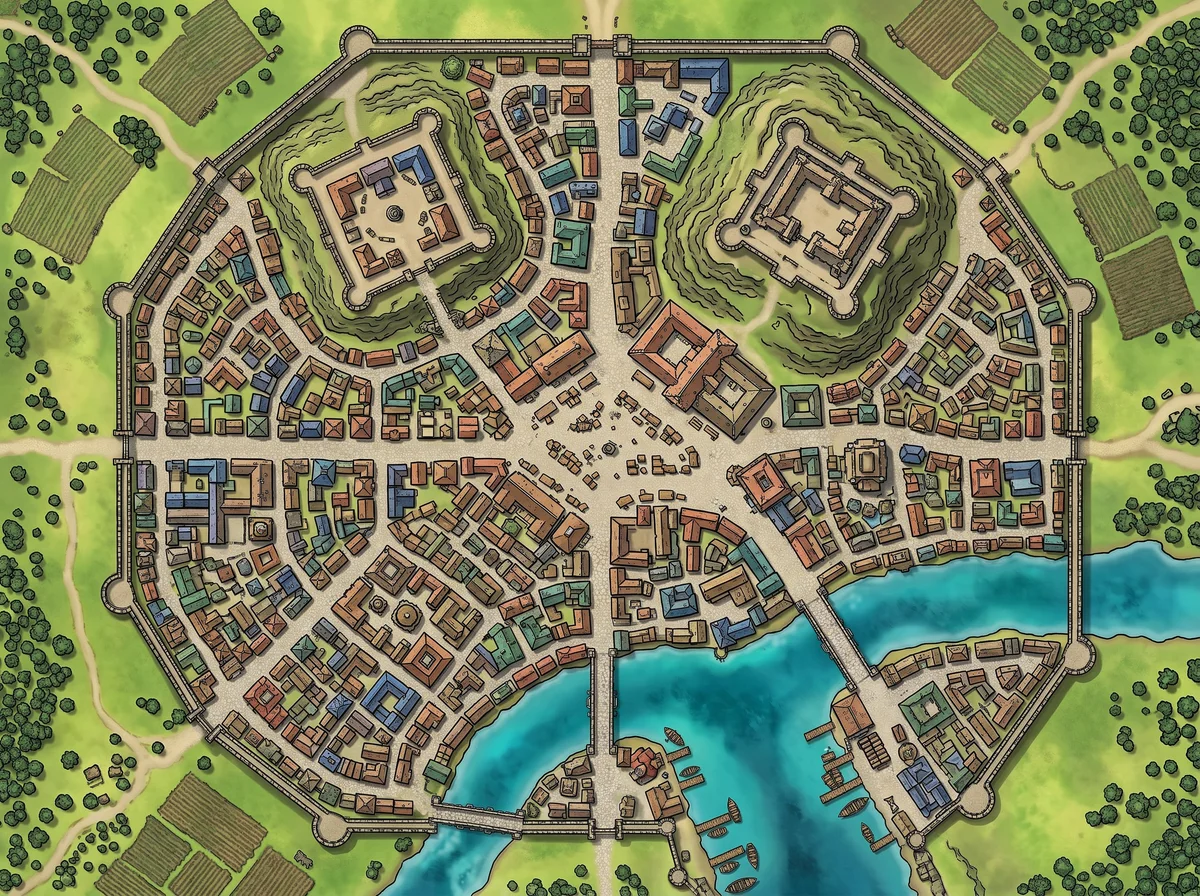 A walled capital with dense interior districts — but notice the area outside the walls. That's where the tent slums should be.
The Quick-Reference Card
For your next fantasy city map, start here:
| # | District | One-Line Function | Default Secret |
|---|---|---|---|
| 1 | Market Quarter | Commerce and information | Someone sells rumors, not goods |
| 2 | Seat of Power | Governance and politics | The real power isn't who you think |
| 3 | Temple District | Faith and moral tension | The temple is hiding something |
| 4 | Docks / Trade Gate | Arrival and the outside world | Something illegal at the border |
| 5 | Residential | Normalcy and tone | Quiet connections to main plot |
| 6 | Undercity (forgotten) | Vertical depth | Old secrets buried underground |
| 7 | Tent Slums (forgotten) | Social depth | The people the city ignores |
Generate your map with the city map generator, name 5-7 districts, plant one secret each, and you have a city that will sustain 3-5 sessions before you need to prep anything new.
I've mapped 15 cities this way. Not one has felt like a repeat. The districts are the same, but the secrets — and the players — are always different.
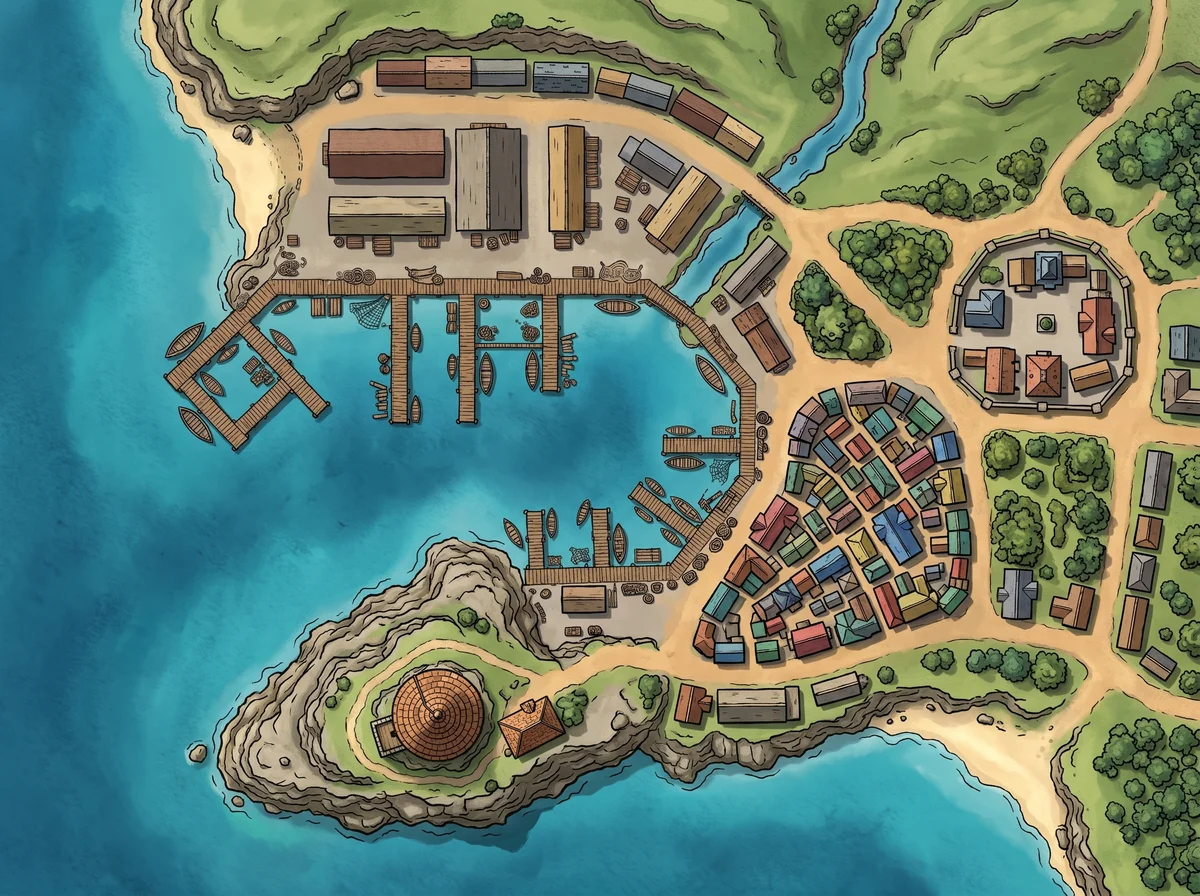 Driftholm, the city that refused to stay small. All 5 core districts plus the Docks that started a smuggling arc nobody planned.
Related Reading
- How One D&D City Map Took Over 12 Sessions — The Driftholm story in full — how 4 districts became a campaign centerpiece.
- Your D&D Town Map Has Too Many Buildings — When you need districts vs. when you need landmarks.
- How to Stock a Hex Crawl With 12 Cities — Placing cities across a world map.
- I Built a Fantasy World in 3 Hours — The broader worldbuilding framework.
- City Map Generator — Generate your 5-district city in under 2 minutes.
- D&D Map Generator — For dungeon, battle, and world maps.
- Fantasy Fortress Design: What Real Castles Teach DMs — The noble/military district expanded into full fortress design.

Written by
Toby
Indie Developer & Creator of FantasyGen
Toby is an independent developer focused on building AI-powered creative tools. He created FantasyGen to help game masters and worldbuilders generate fantasy maps instantly — no artistic skills required.
Continue the Campaign
How to Stock a Hex Crawl With 12 Cities in Under an Hour
A step-by-step workflow for stocking a hex crawl with 12 cities using a random city generator. I prepped the entire Shattered Coast map in 45 minutes flat.
How One D&D City Map Took Over 12 Sessions of My Campaign
I prepped 4 districts for a throwaway port city. Three months later my players refused to leave. How one D&D city map became the center of my entire campaign.
Island Map Design: Coastlines, Secrets, and Why Shape Matters
A 5-step island generator workflow: shape the silhouette, carve coastline features, place harbors, and hide secrets. Design your island map from the outside in.