
Fantasy Fortress Design: What Real Castles Teach DMs
Real castles used concentric walls, murder holes, and arrow loops. Here's how I turned those principles into fantasy fortress encounters my players loved.
Caerphilly Castle in Wales has 30 acres of concentric defenses built in 1268. I stood in the outer ward on a rainy Tuesday last October, staring at a murder hole above the eastern gatehouse, and my first thought was: "That's 3d6 bludgeoning damage from above, no save."
I'd been designing fantasy fortress maps for 3 years and running them for my Wednesday group without ever asking the fundamental question — why do real castles look the way they do? Not aesthetically. Functionally. Why is that wall angled? Why is that passage only 4 feet wide? Why does the gatehouse turn 90 degrees before the inner courtyard?
The answers changed how I build every castle encounter.
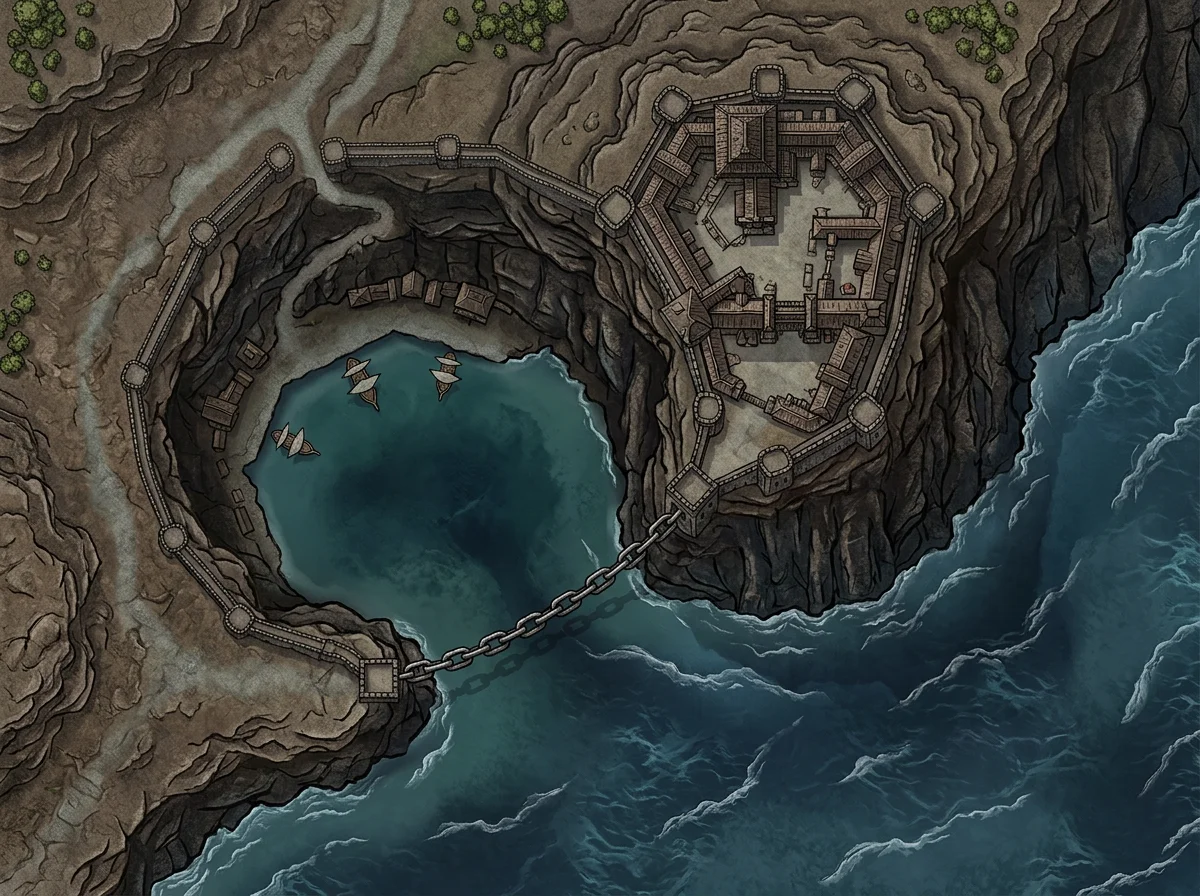
The Research That Changed My Fortress Design
I didn't plan to become obsessed with medieval military architecture. It started with a Wikipedia article on concentric castles and ended with 9 books, 2 castle visits, and a browser history that would concern most people.
Here's what I found: real castle designers were encounter designers. They just called it "defense in depth" instead of "layered encounter pacing."
Edward I of England built 17 castles across Wales between 1277 and 1307. Each one was a masterclass in controlling movement — forcing attackers into predetermined paths where defenders held every advantage. Narrow passages. Overlapping fields of fire. Retreat routes that let a garrison of 30 hold against an army of 300.
The parallels to D&D encounter design are not subtle.
A post by u/DesertDM on r/DMAcademy put it best: "A castle isn't a building. It's a machine for killing people who enter it wrong." That reframe — castle as machine, not as location — is the single most useful lens I've found for fantasy fortress design.
Three Principles I Stole from Real Castles
After months of reading about Edwardian concentric design, Crusader fortifications, and Japanese castle architecture, I distilled everything into 3 principles that actually matter at the table. Everything else is flavor.
Principle 1: Concentric Defense Creates Act Structure
Caerphilly has 3 defensive rings. Krak des Chevaliers has 2 massive concentric walls with a 40-foot killing ground between them. The concept is simple: every ring an attacker breaches reveals another ring behind it.
In D&D terms, this is act structure for a siege encounter.
My players assaulted a fantasy fortress called Greyveil Hold during sessions 36 and 37 of The Shattered Coast. I gave it 3 rings: an outer curtain wall (Act 1 — the breach), a narrow killing ground with arrow loops on both sides (Act 2 — the gauntlet), and an inner keep with a single reinforced door (Act 3 — the final push). Each ring escalated in difficulty. Each ring demanded different tactics.
The result? A 2-session assault that my group planned for 45 minutes before rolling initiative. Marcus wanted to tank through the killing ground. Jess wanted to find the drainage channel I'd hidden on the east side. Dan forgot to prepare Shield. Again.
That planning phase — where players study the map and argue about approach — only happens when the fortress communicates its danger visually. Concentric rings do that instantly. Players look at 3 walls and understand: this will be hard.
Principle 2: Murder Holes and Arrow Loops Create Asymmetric Combat
Here's a contrarian claim most DMs won't agree with: symmetric encounters are boring encounters.
Real castle architects understood this intuitively. A murder hole — an opening in the ceiling of a gatehouse passage — lets defenders pour boiling oil, drop stones, or fire crossbow bolts at people who can't fight back effectively. Arrow loops (those narrow vertical slits in walls) give archers three-quarters cover while exposing attackers to fire with no cover at all.
This is profoundly unfair. That's the point.
Mike Shea at Sly Flourish talks about building encounters where the environment does as much work as the monsters. Murder holes and arrow loops are the purest expression of that idea. The space itself is the enemy.
In Greyveil Hold, I placed 4 murder holes above the gatehouse passage and gave the defenders crossbows with a +5 to hit. My party of 5 level-8 characters took 47 points of damage crossing 30 feet of corridor — and loved it because they'd seen the murder holes on the map, debated how to handle them, and chose to sprint through anyway while Dan cast Fog Cloud upward into the holes.
The asymmetry made the problem interesting. A fair fight in an open room? That's just math. An unfair fight where the terrain is the puzzle? That's D&D.
Principle 3: Machicolations Force Vertical Thinking
Machicolations are those stone overhangs at the top of castle walls — the projecting parapets with holes in the floor that let defenders drop things on people at the base of the wall. Most DMs have never heard the word. I hadn't until I visited Warwick Castle and a tour guide spent 10 minutes explaining how they replaced wooden hoardings after the 13th century.
What machicolations taught me about fantasy fortress design: vertical space is the most underused axis in D&D combat.
A wall with machicolations means the person climbing it faces danger from above and from the wall face. In game terms, that's attacks of opportunity from above, difficult terrain on the climb, and no cover while ascending. It transforms wall-climbing from a single Athletics check into a 3-round encounter with genuine risk.
I now include at least one vertical combat challenge in every fantasy fortress. A 40-foot wall with machicolations above. A tower staircase with murder holes between floors. A rooftop fight where one side has the high ground and the other has to climb under fire.
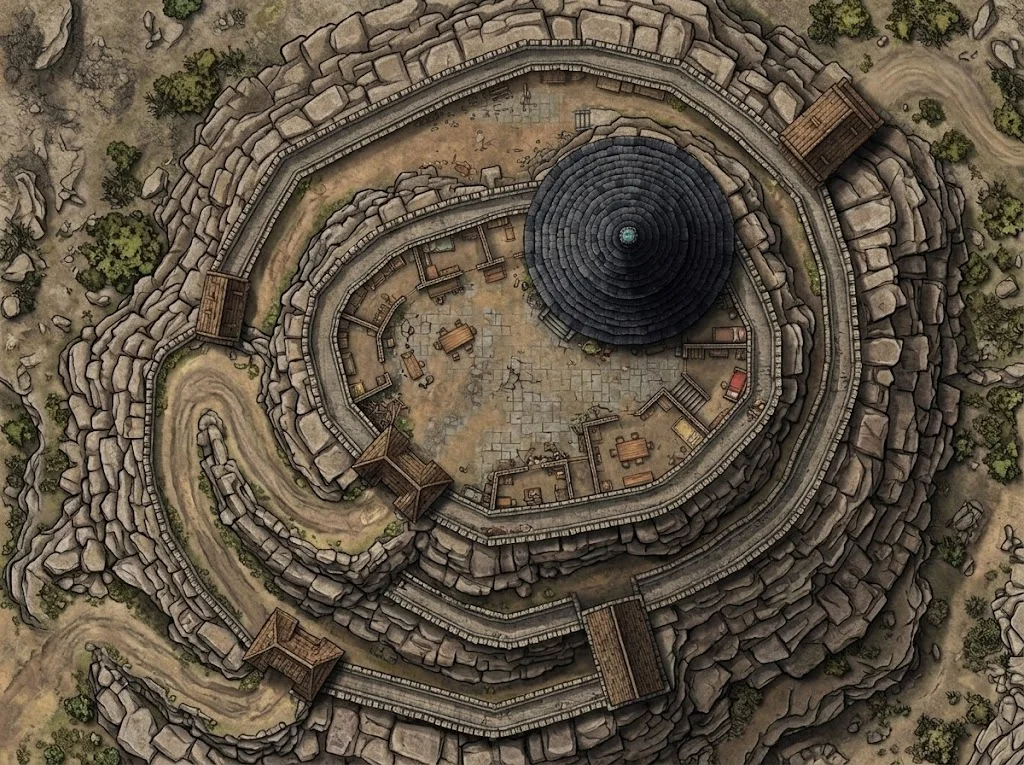 The elevated terrain multiplies defensive advantage — a principle Edward I exploited at every Welsh castle site.
What My Players Actually Loved
Session 37 ended with my group breaching Greyveil Hold's inner keep. Here's what they talked about afterward — not the combat stats, not the loot, but the experience:
The planning phase. I showed them the castle map generator output 20 minutes before the assault began. They spent those 20 minutes arguing, sketching approach routes, assigning roles. Jess counted arrow loops. Marcus estimated how many rounds to cross the killing ground. That's not "wasted time" — that's engagement at its peak.
The murder hole sprint. Dan's Fog Cloud play felt like genius because the map gave him a problem worth solving. If I'd just placed guards in a room, he'd have cast Fireball. The architecture demanded creativity.
The drainage channel. I put a 3-foot-wide channel on the eastern wall — historical castles had them for waste and rainwater. Jess's rogue squeezed through while the party created a distraction at the main gate. She disabled the portcullis mechanism from inside. That moment — a single character changing the siege's trajectory through a detail I borrowed from real castle plumbing — was the highlight of a 2-session arc.
None of these moments came from monster stat blocks.
They came from architecture.
What I'd Do Differently
I researched 9 real castles before designing Greyveil Hold. That was probably 6 too many for a first attempt. Here's what I got wrong:
-
I included too many historical features and the map became unreadable. Barbican, portcullis, murder holes, arrow loops, machicolations, sally port, garderobe tower — all historically accurate, all crammed into a map my players couldn't parse in under 5 minutes. Now I pick 3 features maximum per fortress and make each one mechanically distinct.
-
I assumed players would notice defensive features without narration. I drew arrow loops as thin lines on the map. Nobody saw them. Nobody worried about them. I had to say out loud, "You see narrow slits in the stone — and behind each one, a crossbow bolt catches the light." Description work matters more than map accuracy.
-
I built the fantasy fortress at realistic scale and it was too big for D&D. Caerphilly Castle's outer ward alone is 300 feet across. At 5 feet per square, that's a 60×60 grid — too large for meaningful tactical play. I've since learned to compress distances. My fortresses use 40-60% of real-world scale. The feel of distance matters more than cartographic accuracy.
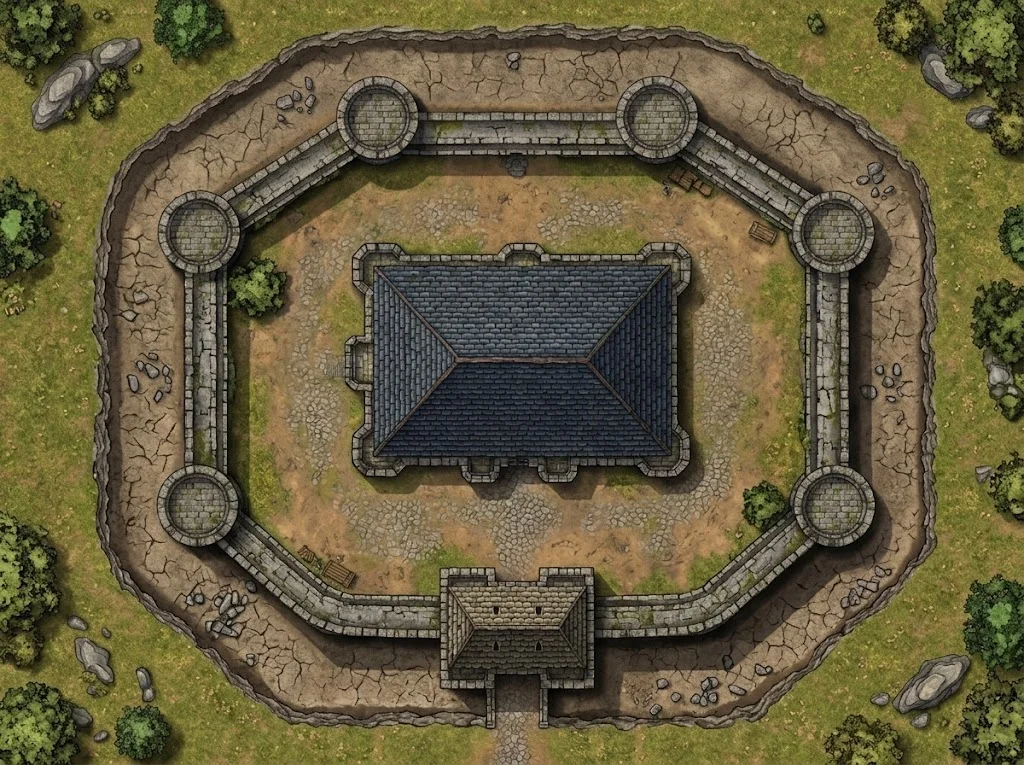 Real castles inspire the layout — but D&D scale requires compression. 60% of historical dimensions keeps the tactical feel without bogging down movement.
When Real Castle Principles Break Down
This approach doesn't work everywhere:
-
Low-magic siege vs. high-magic party. If your players have Passwall, Fly, and Dimension Door, concentric walls become flavor text. At level 13+, design the interior encounters and treat the walls as narrative pacing rather than tactical barriers.
-
Player-owned fortresses. When the party IS the defender, you need castle layouts that are fun to hold, not fun to breach. The psychology inverts — and most of these principles assume the party is attacking. For castle layouts players defend, simplify to 2-3 choke points they can realistically cover.
-
Narrative-first groups. Some tables don't enjoy tactical combat. If your group prefers social encounters and exploration, a fortress is better as a dungeon map generator crawl — room by room, NPC by NPC — than a military assault.
The Broader Principle
Every real castle was designed by someone who understood one thing: space is a weapon.
The angle of a wall. The width of a passage. The height of an opening. None of these are aesthetic choices — they're tactical ones. And the moment I started treating fantasy fortress design as encounter design rather than architecture, my castle sessions went from "fine" to "memorable."
You don't need to visit Caerphilly or read 9 books on Edwardian military engineering. You need 3 questions:
- Where does the defender have advantage that the attacker doesn't?
- Where is the attacker forced to go — and what's waiting there?
- What single feature would make your rogue feel like a genius for exploiting?
Answer those, feed them into a castle map generator, and you'll get a fantasy fortress that fights like a machine — not a building with swords inside it.
The next time you drop a fortress in front of your players, don't ask "what does this castle look like?" Ask what Edward I would have asked: "How does this castle kill the people trying to take it?"
That question — asked seriously, answered with specifics — is the difference between a courtyard encounter that falls flat and a siege your group remembers for years.
Related Reading
- How to Build a D&D Castle Map That Players Want to Siege — the step-by-step workflow for designing layered castle maps with kill zones and breach points
- Battle Map Mistakes That Kill Combat — terrain errors that flatten encounters, including the "pretty parking lot" problem
- Choke Points, Cover, and Why Most Battle Maps Are Flat — deep dive into exactly why asymmetric terrain creates better fights
- How to Prep a Dungeon in 20 Minutes — the time-boxed approach I use for fortress interiors when I don't have 2 days to research medieval architecture

Written by
Toby
Indie Developer & Creator of FantasyGen
Toby is an independent developer focused on building AI-powered creative tools. He created FantasyGen to help game masters and worldbuilders generate fantasy maps instantly — no artistic skills required.
Continue the Campaign
D&D Castle Maps: From Ruined Keep to Sprawling Citadel
Four castle map scales for D&D — from ruined keep to sprawling citadel. Compare rooms, prep time, and tactical depth to pick the right one for your table.
5 Castle Layouts I've Used in 4 Different Campaigns
5 castle layouts from real D&D campaigns — border keeps, mountain fortresses, coastal citadels, ruins, and palace-fortresses with tactical insights for each.
How to Build a D&D Castle Map That Players Want to Siege
Step-by-step d&d castle map design with layered defenses, gatehouses, and tactical killzones that turn a flat keep into a siege players talk about for weeks.