

How to Build a D&D Castle Map That Players Want to Siege
Step-by-step d&d castle map design with layered defenses, gatehouses, and tactical killzones that turn a flat keep into a siege players talk about for weeks.
Session 31 of The Shattered Coast. My Wednesday group had spent two full sessions scouting a coastal fortress called Thornwall Keep — counting guards, mapping patrol routes, debating whether to assault the main gate or scale the sea cliffs at low tide. Marcus's fighter wanted a frontal charge. Jess's rogue wanted the sewers. Dan's wizard forgot to prepare Knock, which would have solved two of their problems instantly.
The siege took 4 hours of real-time play across a single session. It's the encounter my group still references 16 sessions later. And the reason it worked had nothing to do with monster stat blocks or dramatic narration. It worked because I spent 45 minutes designing a d&d castle map that was built to be attacked.
Not admired. Attacked.
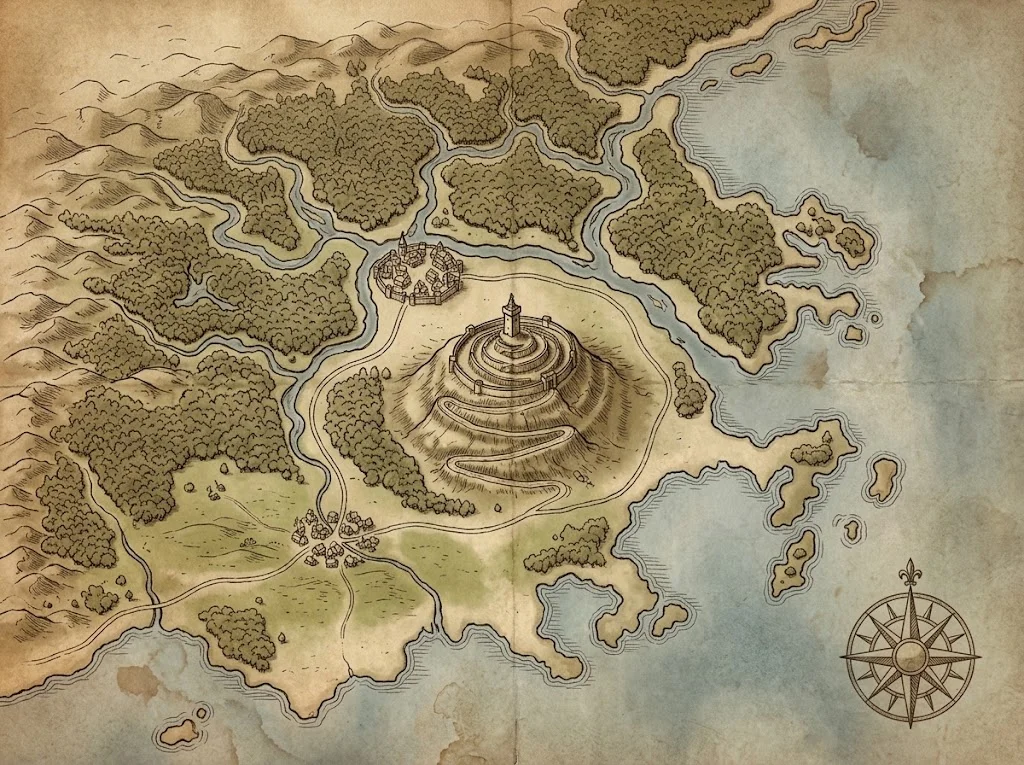
The Prettiest Castle Map Is the Worst Siege Map
Most DMs design castle maps the way they design any location: make it look cool, drop some monsters inside, see what happens. I did this for years. Symmetrical walls. Evenly spaced towers. A big open courtyard that looked impressive on Foundry VTT but played like a parking lot.
Here's the contrarian take: the more aesthetically balanced your castle layout is, the worse your siege encounter will be.
Real medieval castles were profoundly unfair. Every design choice existed to give defenders an advantage and make attackers miserable. Concentric walls forced invaders into killing fields. Gatehouse passages turned 90 degrees so battering rams couldn't build momentum. Arrow slits gave archers cover while exposing nothing. A post on r/DMAcademy about concentric castle design changed how I think about this — the user argued that a d&d castle map should feel like a puzzle the players solve with violence, not a building they walk through.
That reframe changed everything for me.
Step 1: Start with Kill Zones, Not Architecture (15 Minutes)
Forget the floor plan. Open your castle map generator or a blank sheet and mark three things before you draw a single wall:
- Where do defenders shoot from? Battlements, arrow slits, murder holes above the gatehouse. Mark these positions first.
- Where do attackers get funneled? Narrow gates, bridge crossings, courtyard entrances. These are your choke points.
- Where is the open ground with no cover? This is your killing field — the space between the outer wall and the inner wall where anyone crossing is exposed.
The entire d&d castle map flows from these three decisions. Walls exist to create kill zones. Towers exist to give line-of-sight over kill zones. The keep exists as the final fallback when every kill zone has been breached.
Time box: I spend 15 minutes total on this step. Sketch the kill zones on scratch paper, then build the castle around them. If you start with the architecture and add kill zones later, you end up with a castle that looks great and fights flat.
The failure that taught me this: my very first castle map was a 120-foot square with 4 towers at the corners. Perfectly symmetrical. Perfectly fair. The party breached the south wall in round 2 and fought in the courtyard for 8 rounds with zero tactical decisions beyond "who do I hit next." No positioning. No terrain advantages. No layered retreat for the defenders. I'd built a dnd castle that looked like a castle but fought like an empty field.
Step 2: Layer Defenses Like a Real Fortress (10 Minutes)
The single biggest upgrade I made to my castle layouts was adding depth. Not more rooms — more layers.
A good fantasy fortress has at least 3 defensive rings:
| Ring | What It Is | Tactical Purpose |
|---|---|---|
| Outer wall | First barrier, usually with battlements | Forces attackers to commit resources to breach |
| Barbican / gatehouse | Fortified entrance between walls | Choke point with murder holes, portcullis, oil traps |
| Inner courtyard + keep | The core of the castle | Final stand — smallest space, most defenders |
Each ring should require a different approach to breach. The outer wall might need siege equipment or Athletics checks to scale. The gatehouse might need a key, a spell, or sheer brute force. The keep might have a barred door that takes 3 rounds to break while archers fire from above.
Justin Alexander at The Alexandrian writes about the "Three Clue Rule" — the idea that players need at least three paths to any critical piece of information. I apply the same principle to castle breaches: every defensive ring should have at least 2 entry methods. The front gate and a crumbling section of wall. The main door and a sewer grate. The tower stairs and a window that a Small creature could squeeze through.
This is what turned Jess's rogue from bored spectator to MVP at Thornwall Keep. While Marcus battered the front gate, Jess climbed through a drainage pipe I'd marked on the map as "rusted iron grate, DC 14 to pry open." Two separate breach points. Two separate encounters running simultaneously. That's the magic of layered castle layouts.
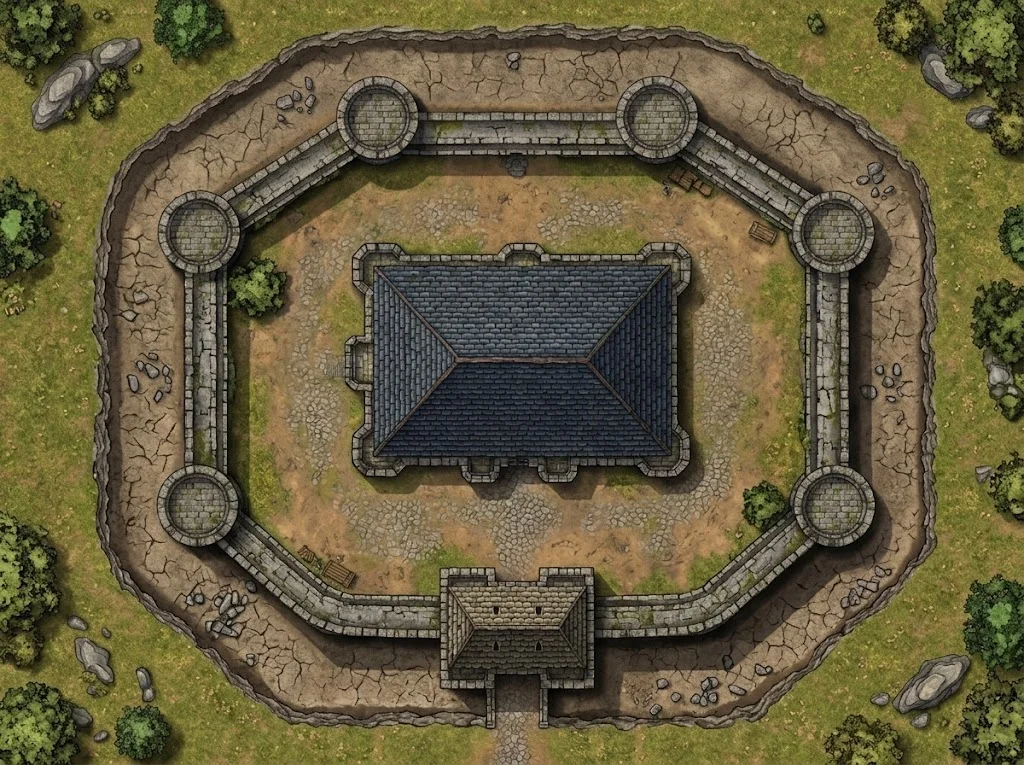 Prompt: "Top-down medieval stone castle with concentric defensive walls, central keep, barbican gatehouse, and courtyard between inner and outer walls."
Step 3: Make Every Room Fight Differently (20 Minutes)
Here's where most d&d castle map designs fall apart. The walls are great. The layers exist. But every room inside plays the same: enter, fight monsters, move to next room.
Each space in your castle should enforce a different type of combat:
Battlements — ranged warfare. Defenders have three-quarters cover behind crenellations (PHB, +5 AC). Attackers climbing ladders are exposed and can't use shields. I run battlement fights as a race: can the party clear the defenders before reinforcements arrive from the towers?
Gatehouse passage — the ultimate choke point. A 10-foot-wide corridor with murder holes in the ceiling and a portcullis at each end. If defenders drop both portcullises, the party is trapped in a kill box. Mike Shea at Sly Flourish calls locations like this "fantastic locations" — spaces that change the encounter just by existing. A gatehouse kill box is the most fantastic location in any castle.
Courtyard — the killing field. Deliberately minimal cover. 60 feet across at minimum so ranged combat matters. Defenders on the surrounding walls have elevation and cover; attackers in the open have neither. I always add one piece of incidental cover — an overturned cart, a well — because players who spot it feel clever for using it.
The great hall / keep — the final encounter space. After tight corridors and exposed courtyards, the great hall is large and interior. I add elevated platforms, pillars for line-of-sight blocking, and at least one environmental hazard (a chandelier to drop, a fireplace to shove someone into).
I generate the base castle layout with the castle map generator and then annotate each room with its combat role. Takes 20 minutes. Half of that is choosing which encounter goes where.
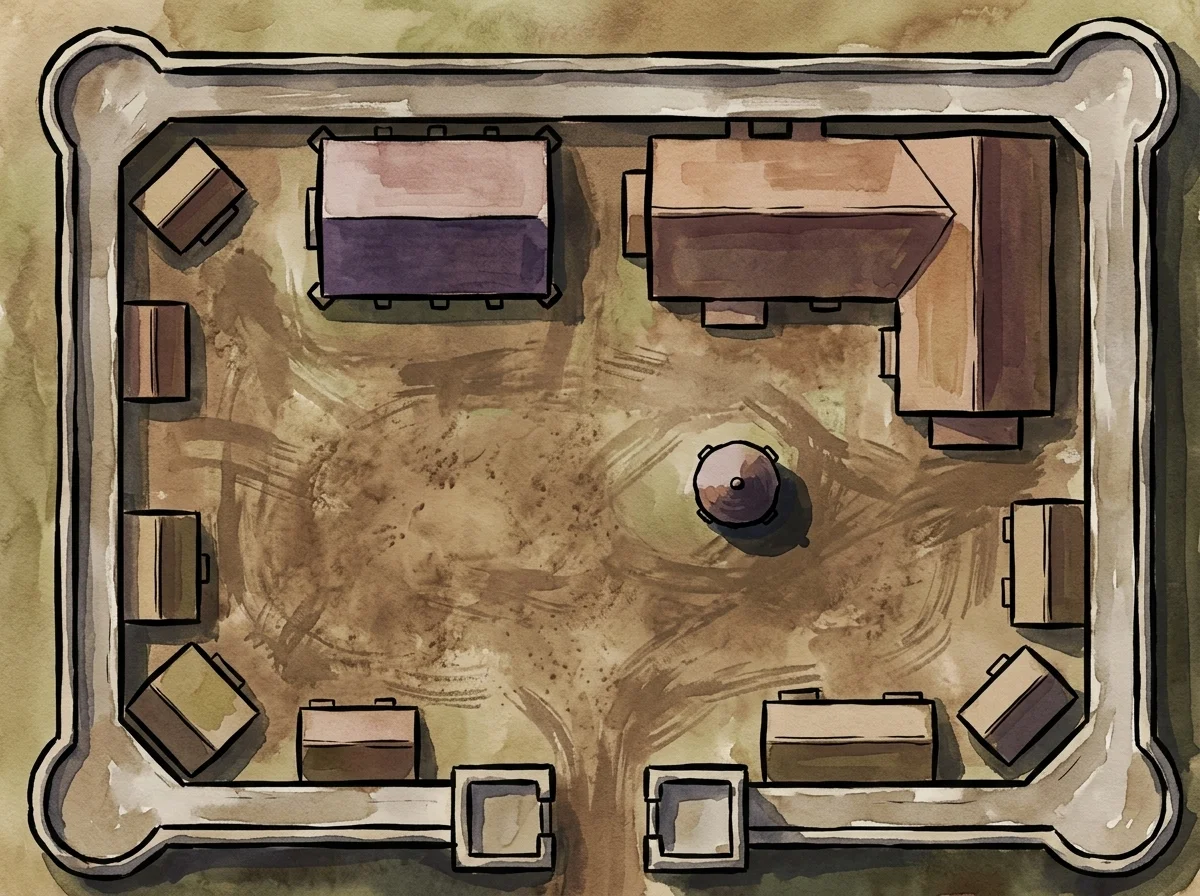 Prompt: "Top-down castle courtyard bailey with inner keep, defensive walls, open ground, and stone buildings along the perimeter."
What I Got Wrong Building Castle Maps
I've designed 6 castle siege maps across The Shattered Coast and various one-shots. Here's what I messed up:
-
I made a symmetrical fortress and called it balanced. Four identical walls, four identical towers. Symmetry means every approach is equally viable — which means there's no wrong approach, no tactical dilemma, no reason to scout. After that session, I started making every castle deliberately lopsided: one weak wall, one strong gate, one blind spot the defenders don't cover.
-
My courtyards were too small. A 30-foot courtyard means everyone is in melee range by round 2. Ranged combat stops mattering. I now make courtyards at least 60 feet across — big enough that crossing the open ground under arrow fire is a genuine risk.
-
I forgot to give the rogue anything to do. Siege combat favors fighters and spellcasters. My first castle had no back entrance, no sewer access, no scalable walls with handholds. Jess sat there for 40 minutes rolling attacks at the front gate. Now every castle map has at least one infiltration route — a route that only works for one or two characters while the rest of the party creates a distraction.
-
I put the boss in the first room the party reached. Thornwall Keep's second draft had the enemy commander standing in the gatehouse. The party killed him in round 3 and the remaining 6 rooms felt pointless. The boss goes in the keep. Always. Make the party earn every floor.
When Castle Siege Maps Don't Work
This whole approach breaks in a few scenarios:
-
Levels 1-3. Low-level parties don't have the tools for a real siege. No Fly, no Knock, no Shatter, no siege equipment budget. At those levels, I run castle infiltration missions instead — sneak in, steal the MacGuffin, sneak out. That's a dungeon map generator job, not a castle siege.
-
The party has unrestricted flight. Fly, Dimension Door, or a Roc mount invalidates walls entirely. If the party can bypass every defensive layer, design for the interior encounters instead and treat the walls as flavor.
-
Solo infiltration one-shots. If only one player is breaching the castle, you need a dungeon with castle aesthetics — not a siege map. Different structure, different pacing.
Tools I Actually Use for D&D Castle Maps
FantasyGen — my primary castle map generator for the last 14 months. I describe the castle type ("concentric coastal fortress with sea cliff on the south side, barbican gatehouse to the north, courtyard with minimal cover") and iterate from there. 11 castle maps generated, 8 needed only minor annotation before hitting the table.
Foundry VTT ($50 one-time) — dynamic lighting matters for castles. Line-of-sight from battlements differs from line-of-sight in the courtyard. Murder holes create weird angles. Foundry handles all of this natively.
The DMG, Chapter 8 (p. 255-256) — the siege equipment table. Battering rams, siege towers, trebuchets. I print this page for every castle session. Most DMs forget these rules exist, but they're exactly what makes a siege feel like a siege rather than "we attack the door."
For interior room-by-room layouts, I generate those separately with a battle map generator — one map per key encounter. The overview castle map handles the macro siege; individual battle maps handle the room-to-room fights.
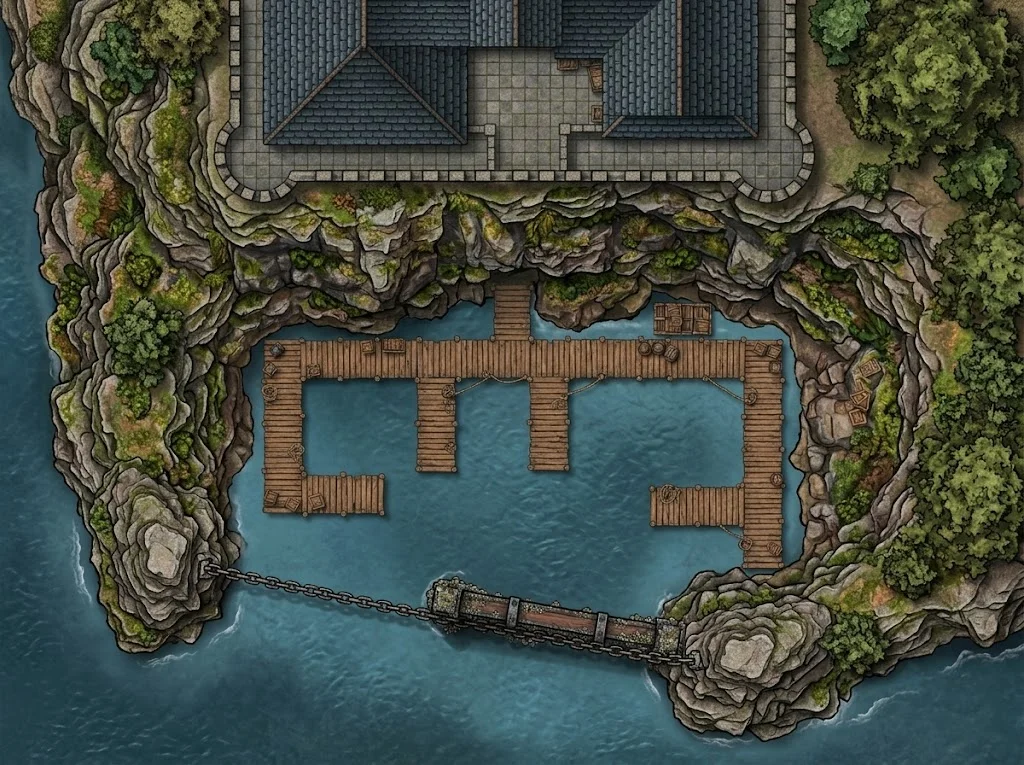 Prompt: "Top-down coastal castle fortress built into sea cliffs, with harbor, defensive towers, and a winding path up the cliff face."
Castle Siege Map Checklist
BEFORE THE SESSION:
□ 3+ kill zones marked (battlements, gatehouse, courtyard)
□ 2-3 defensive rings (outer wall → gatehouse → keep)
□ Each ring has 2+ breach methods
□ Courtyard is 60ft+ across
□ At least 1 infiltration route for rogues
□ Boss is in the keep, not the first room
□ Rooms fight differently (ranged / choke / open / interior)
□ DMG siege equipment table printed (p. 255-256)

DURING THE SESSION:
□ Let players scout and plan (this IS the encounter)
□ Run simultaneous breaches if the party splits
□ Defenders retreat inward as rings fall
The next session of The Shattered Coast — session 48 — takes my Wednesday group to Fort Ironcrest, a mountain fortress with a frozen moat and exactly one functioning gate. I've already drawn the kill zones. The courtyard is 70 feet wide with a single overturned wagon for cover. There's a collapsed section of the east wall that only Jess has spotted on her scouting map.
Marcus is going to love the front gate. Jess is going to love the collapsed wall. Dan is going to forget to prepare Shatter again.
Pick one castle from your campaign — any castle your players haven't reached yet. Throw out the symmetry. Draw the kill zones first. Give the rogue a back door. Your players will spend more time planning the assault than fighting it, and that planning phase? That's some of the best D&D you'll ever run.
Related Reading
- Battle Map Mistakes That Kill Combat — the 3 terrain errors that flatten every encounter, including castle fights
- Choke Points, Cover, and Why Most Battle Maps Are Flat — deep dive into the terrain features that make castle rooms tactically interesting
- How to Prep a Dungeon in 20 Minutes — the same time-boxed workflow I use for castle interiors
- 5 Battle Map Themes I Reuse Every Campaign — bridge crossings and cave ambushes use the same layered-defense thinking

Written by
Toby
Indie Developer & Creator of FantasyGen
Toby is an independent developer focused on building AI-powered creative tools. He created FantasyGen to help game masters and worldbuilders generate fantasy maps instantly — no artistic skills required.
Continue the Campaign
D&D Castle Maps: From Ruined Keep to Sprawling Citadel
Four castle map scales for D&D — from ruined keep to sprawling citadel. Compare rooms, prep time, and tactical depth to pick the right one for your table.
Fantasy Fortress Design: What Real Castles Teach DMs
Real castles used concentric walls, murder holes, and arrow loops. Here's how I turned those principles into fantasy fortress encounters my players loved.
5 Castle Layouts I've Used in 4 Different Campaigns
5 castle layouts from real D&D campaigns — border keeps, mountain fortresses, coastal citadels, ruins, and palace-fortresses with tactical insights for each.