

D&D Castle Maps: From Ruined Keep to Sprawling Citadel
Four castle map scales for D&D — from ruined keep to sprawling citadel. Compare rooms, prep time, and tactical depth to pick the right one for your table.
Over 340 sessions and 4 groups, I've put castle maps on the table ranging from a 6-room ruin that took 45 minutes of play to a 40-room citadel that consumed an entire 8-session arc. The gap between a castle that sings and one that collapses at your table isn't about wall thickness or tower count.
It's scale.
And most DMs pick the wrong one. Not "wrong" as in bad design — wrong as in mismatched. A sprawling fantasy fortress for a one-shot. A crumbling keep for a campaign climax. The scale of your castle map determines how many sessions it fills, how much prep it demands, and whether your players walk away buzzing about it or just... walk away.
This is the comparison I wish someone had handed me before I spent 7 hours prepping a 28-room fortress my Wednesday group explored exactly 9 rooms of before time ran out.
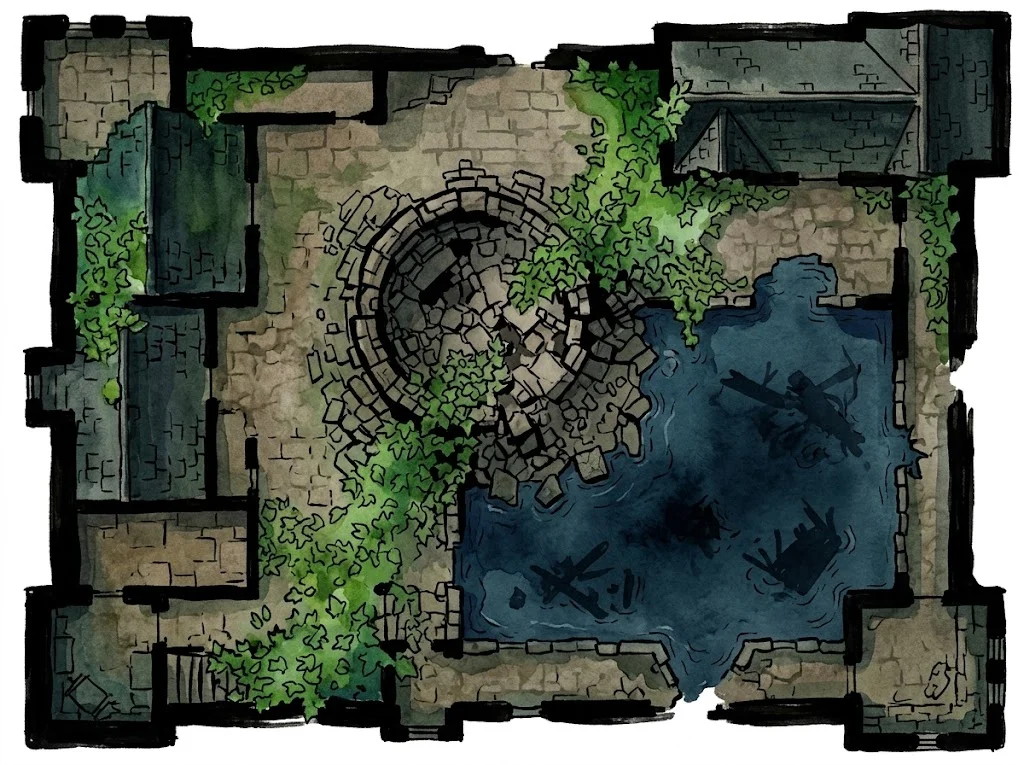
The Scale Problem Nobody Talks About
Here's what most d&d castle map advice gets wrong: it treats every castle as the same design problem. "Add battlements. Layer concentric walls. Place murder holes above the gatehouse." Solid advice — if you're running a multi-session siege. Terrible advice if the party needs to clear a crumbling watchtower in 90 minutes of table time.
Mike Shea at Sly Flourish has written extensively about matching your prep to the session you're actually running, not the session you fantasize about running. I've taken that principle and applied it specifically to castle layouts: the right castle map is the one that fits your remaining session time, not your architectural ambitions.
I spent my first 2 years of DMing using exactly one scale for every castle: the full 20-room fortress. Every noble had concentric walls. Every bandit leader operated from a gatehouse with kill zones. I'd prep for 4 hours, and the party would either blitz through in 90 minutes or barely scratch the surface before the session clock ran out.
That pattern broke when I started asking one question before drawing anything.
Four Castle Map Scales Compared
The question is simple: how many sessions should this castle fill?
The answer sorts every castle into one of 4 tiers. I keep this table taped inside my DM screen, and every castle decision starts here.
| Scale | Rooms | Prep Time | Session Coverage | Tactical Complexity | Best For |
|---|---|---|---|---|---|
| Ruined Keep | 4-8 | 20-30 min | 1 session (partial) | Low — exploration + 1-2 encounters | Side quest, low-level crawl, flavor |
| Fortified Manor | 8-15 | 45-90 min | 1-2 sessions | Medium — social + combat blend | Intrigue, heist, noble confrontation |
| Full Castle | 15-25 | 2-4 hours | 2-4 sessions | High — siege mechanics, layered defense | Mid-campaign siege, faction warfare |
| Sprawling Citadel | 25-40+ | 6-10 hours | 4-8+ sessions | Very High — factions, shifting objectives | Campaign climax, war arc, endgame |
The jump between tiers isn't linear. Going from a fortified manor to a full castle doesn't double your prep — it roughly triples it, because layered defenses create exponential complexity. Every defensive ring multiplies the number of tactical decisions you have to plan for.
Tier 1: The Ruined Keep — Maximum Atmosphere, Minimum Prep
A ruined keep is 4-8 rooms with partial walls, collapsed sections, and open sky where the roof used to be. It's the castle equivalent of a 5-room dungeon — players enter, explore, hit something dangerous, and leave within a single session.
When I use it: levels 1-4 side quests. A bandit hideout in an old watchtower. An ancestral ruin the local lord wants investigated for 200 gold. Any castle that serves the story without becoming the story.
What makes it work: atmosphere over architecture. A ruin doesn't need defensive logic because nobody's defending it. The walls are crumbling. The arrow slits look out onto nothing. Tension comes from what moved in after the last garrison left — not from battlements and kill zones.
I ran one for a Friday one-shot last month: 6 rooms total. Collapsed gatehouse, overgrown courtyard, intact cellar, ruined great hall, exposed tower staircase, and a single sealed chamber at the top. Prep took 25 minutes. The group explored it in about 90 minutes of play, which was exactly right — the keep was one piece of a larger adventure, not the whole session.
The trap: over-detailing a ruin. If you're placing guards, patrol schedules, and three defensive rings around a 6-room keep, you've silently jumped to the next tier. Scale and detail need to match.
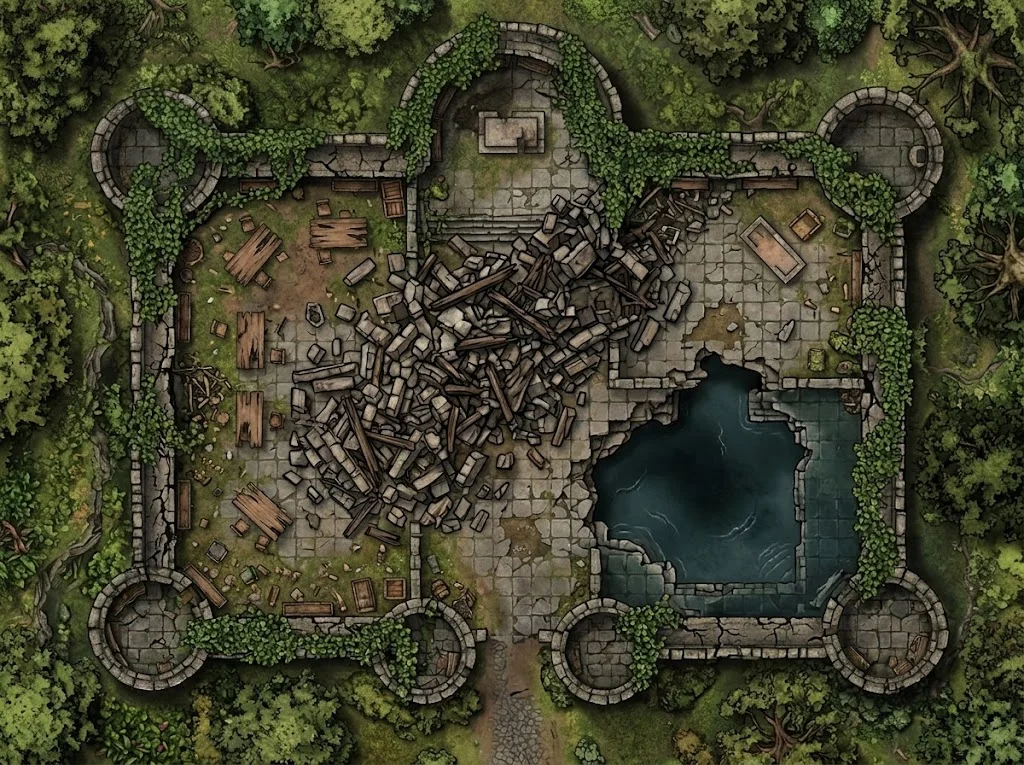 A ruined keep like this fills roughly 90 minutes of table time. Add more rooms and you've quietly crossed into fortified manor territory.
Tier 2: The Fortified Manor — Where Social Meets Tactical
This is the castle map I run most often and the one I see discussed least. A fortified manor is 8-15 rooms: a working residence with defensive features, not a military fortress. A noble's country estate with a curtain wall. A merchant prince's compound with a private guard.
When I use it: political sessions, heists, assassination plots — any scenario where social and combat might collide inside the same building.
What makes it work: the dual nature. Half the rooms are social spaces — dining hall, study, bedchambers, servant quarters. Half are tactical — guard posts, armory, walled courtyard, a cellar that doubles as a panic room. Players have to navigate both. You can't just kick down the door when there are 40 guests at dinner. You can't just talk your way past everything when the lord keeps 8 armed guards.
A thread on r/DMAcademy about castle infiltration missions changed my entire approach to manors: design the building's daily routine before you design its floor plan. Where do guards stand during dinner? When are the gates open? When does the lord retire to his study? Those questions shape the map more than any architectural decision.
My best fortified manor was Blackthorn Hall — a 12-room estate I ran during the Driftholm smuggling arc in The Shattered Coast. The party attended a merchant's banquet as cover for stealing shipping manifests from the lord's study. Jess's rogue was in her element. Marcus's fighter had to roleplay through the entire social half, which he hated — and the table loved. The session split perfectly: 2 hours of social maneuvering, 45 minutes of violent escape when they tripped an alarm ward in the hallway.
The trap: making every room combat-ready. A manor has kitchens, closets, and pantries. Not every space needs a tactical encounter. Some rooms just need a locked door and a DC.
Tier 3: The Full Castle — Multi-Session Siege
This is what most people picture when they hear "d&d castle map." Fifteen to 25 rooms with concentric defensive rings, a proper gatehouse, battlements, a courtyard, and a central keep. A military structure built to be attacked and defended.
When I use it: mid-campaign climax encounters. Faction warfare. The assault on the villain's stronghold that the party has spent 3 sessions scouting and planning.
What makes it work: layered defense. I covered this in detail in my guide to building siege-ready castle maps — the key insight is that every defensive ring should require a different approach to breach. The outer wall calls for Athletics checks or siege equipment. The gatehouse is a choke point with murder holes overhead. The keep has barred doors and the final stand.
A full castle takes 2-4 sessions to resolve because each defensive ring is its own encounter. That's the whole point. The multi-session format gives players room to scout, plan, fail, regroup, and assault again. That planning phase is some of the best D&D I've ever run at a fantasy fortress.
I generate the base castle layouts with the castle map generator and then spend the majority of my prep on defender behavior: what happens when the outer wall falls? Do the guards retreat to the keep or counterattack through the postern gate? How does the commander respond to a breach on the east side while the main force hits the gatehouse?
The trap: forgetting the interior. Most siege-focused castle maps obsess over the exterior — walls, towers, courtyards. But once the party breaches the keep, you need interior rooms: great hall, throne room, armory, dungeon cells. If you haven't prepped those, the climax of a 3-session siege is "you enter an empty room with the boss standing there."
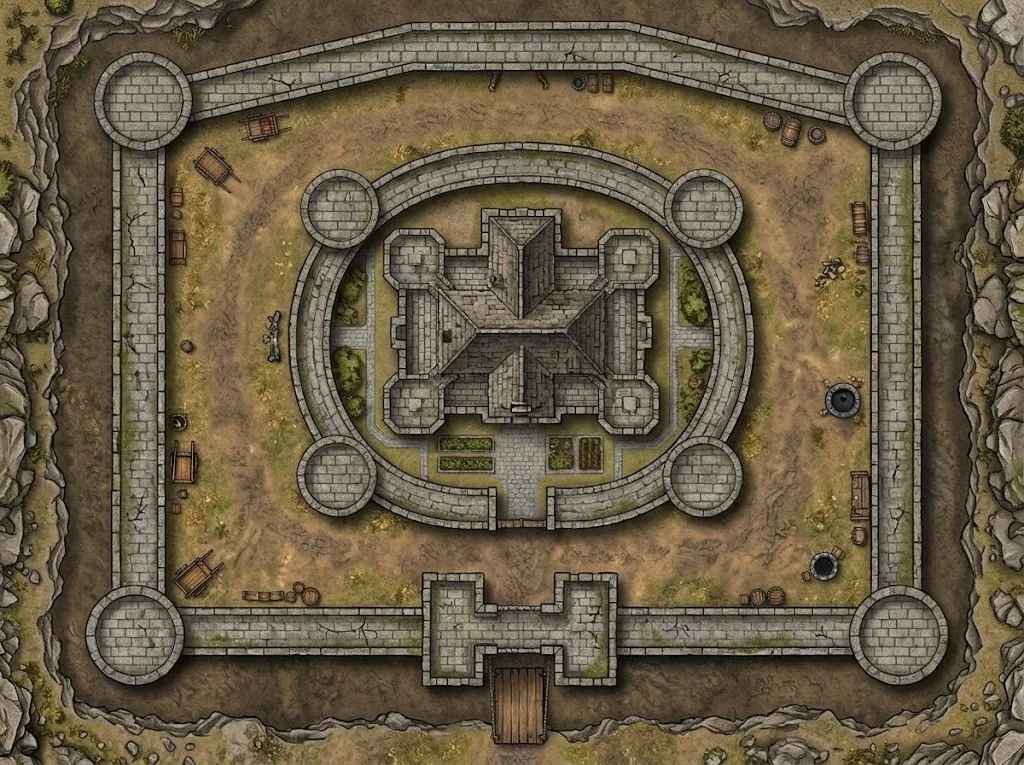 A full castle with layered defenses takes 2-4 sessions to siege. Each ring is its own encounter — prep accordingly.
Tier 4: The Sprawling Citadel — Campaign-Defining
A sprawling citadel stretches to 25-40+ rooms spread across multiple districts, levels, or wings. Think Minas Tirith, the Red Keep, Hogwarts. It's not just a military structure — it's a city within walls, with factions, internal politics, and its own ecology.
When I use it: campaign finales, war arcs, or strongholds the party claims and operates from across multiple sessions. A citadel becomes a character in your campaign, not just a location on it.
What separates it from a full castle: internal politics. Guards vs. servants vs. prisoners vs. nobles — all occupying the same structure with competing loyalties. The party doesn't just breach from outside. They navigate from within. Alliances shift. Intel matters more than initiative rolls.
I've run exactly 2 true citadels across 340 sessions. The first was a disaster — 38 rooms prepped over 10 hours, and the party bypassed 26 of them with a well-placed Dimension Door and an alliance with the kitchen staff. Sixteen sessions of combined prep, gone in 2 sessions. The second was the final arc of my pre-Shattered Coast campaign: a tiered mountain fortress where each level belonged to a different faction. Six sessions of playing factions against each other before the siege even started. That's 6 sessions of gameplay generated by architecture, not plot.
Prep reality: 6-10 hours minimum, spread across multiple weeks. You're effectively building a dungeon the size of a small town. I break citadels into wings and prep one wing per session — never the whole structure at once.
The trap: running a citadel like an enlarged castle. Castle siege means breach from outside. Citadel means navigate from within. Run a 35-room citadel as a linear assault and your players will lose the map by room 12 — and so will you.
Which Scale for Which Moment?
| Campaign Moment | Recommended Scale | Why |
|---|---|---|
| Side quest, levels 1-4 | Ruined Keep | Low prep, high atmosphere, fits inside a larger session |
| Political intrigue or heist | Fortified Manor | Social + tactical duality matches the scenario |
| Faction war climax | Full Castle | Multi-session siege with layered encounters |
| Campaign finale or war arc | Sprawling Citadel | Weeks of gameplay from a single structure |
| One-shot (3-4 hours) | Keep or Manor | Full castles can't resolve in one session |
| Recurring player base | Manor or Citadel | Rooms the party "lives in" between adventures |
The mistake I see most often on r/DMAcademy is DMs building a full castle for a one-shot. Fifteen rooms in 3 hours means rushing every encounter or abandoning half the map. A fortified manor with 10 well-designed rooms beats a 20-room castle where the party skips 12 of them every time.
For a deeper breakdown on castle layouts at the full-castle tier, my castle layouts for D&D campaigns guide covers defensive ring design in detail. For the worldbuilding angle of a fantasy fortress — why it exists, who built it, what it means politically — see the fantasy fortress design guide.
Next time you place a castle in your campaign, don't start with the floor plan. Start with the tier. Open the castle map generator, pick the scale that matches your session count, and build from there. A 6-room ruin prepped in 25 minutes can be more memorable than a 30-room fortress that took all weekend.
The best castle map isn't the biggest one. It's the one that ends when the session does.
Related Reading
- How to Build a D&D Castle Map That Players Want to Siege — tactical deep dive into the full castle tier with kill zones and layered defenses
- Battle Map Mistakes That Kill Combat — terrain errors that flatten encounters at every castle scale
- How to Prep a Dungeon in 20 Minutes — the time-boxed framework I use for ruined keep prep
- How One D&D City Map Took Over 12 Sessions — when a citadel-scale structure eats the campaign in the best way

Written by
Toby
Indie Developer & Creator of FantasyGen
Toby is an independent developer focused on building AI-powered creative tools. He created FantasyGen to help game masters and worldbuilders generate fantasy maps instantly — no artistic skills required.
Continue the Campaign
Fantasy Fortress Design: What Real Castles Teach DMs
Real castles used concentric walls, murder holes, and arrow loops. Here's how I turned those principles into fantasy fortress encounters my players loved.
5 Castle Layouts I've Used in 4 Different Campaigns
5 castle layouts from real D&D campaigns — border keeps, mountain fortresses, coastal citadels, ruins, and palace-fortresses with tactical insights for each.
How to Build a D&D Castle Map That Players Want to Siege
Step-by-step d&d castle map design with layered defenses, gatehouses, and tactical killzones that turn a flat keep into a siege players talk about for weeks.