

Your D&D Town Map Has Too Many Buildings
Most DMs draw town maps like shrunken cities. A village needs 5 landmarks and one road out, not 200 rooftops. Here's when to zoom in and when to keep it sparse.
Here's a question nobody asks: why does your roadside village have more buildings than a medieval English market town?
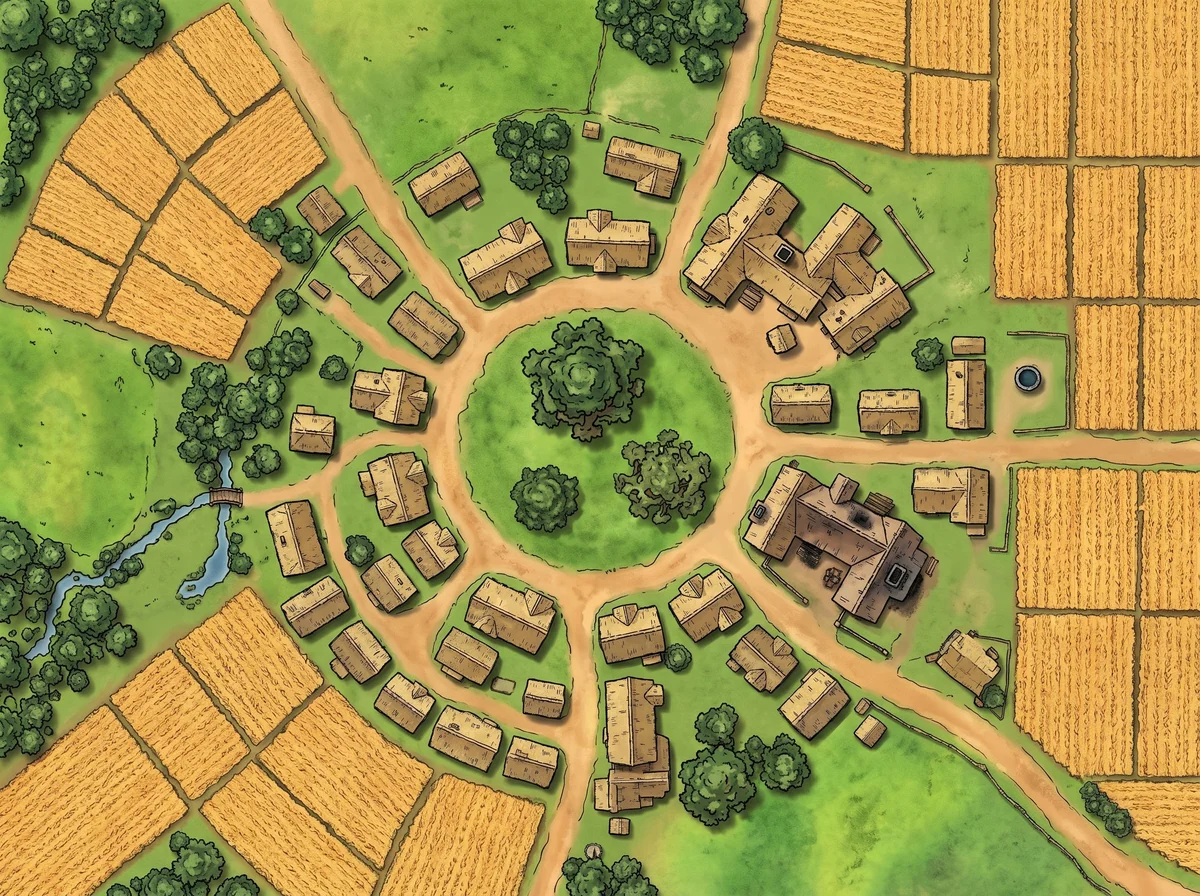
I've seen town maps on r/DMAcademy with 200+ rooftops for a settlement the DM described as "a quiet farming village." That's not a village. That's Bristol in 1400. A real medieval village — the kind your players ride through between dungeons — had 20-50 households. One church. One well. Maybe a blacksmith if you were lucky.
The instinct to fill every inch of a D&D town map with buildings comes from the same place as the instinct to write 10 pages of backstory for a one-session NPC: more detail feels like more effort, which feels like better prep.
It's not. And I spent 2 years learning that the hard way.
The Scale Problem
A town is not a small city. A city is not a large town. They work differently at the table, and they need different maps.
The distinction matters because map density drives player behavior. Hand your players a city map packed with labeled buildings and they'll want to explore all of them. Hand them a sparse village map with 5 labeled landmarks and they'll interact with those 5 landmarks — which is exactly what you prepped for.
Here's how I think about it after running the same Wednesday group through 47 sessions of the Shattered Coast:
| Settlement Type | Population | Landmarks on Map | NPC Prep | Session Time |
|---|---|---|---|---|
| Village | 50-300 | 3-5 | 1-2 named | 15-30 min |
| Town | 300-3,000 | 5-10 | 2-4 named | 30-90 min |
| City | 3,000+ | 10-20 (districts, not buildings) | 4+ named | Multi-session |
The numbers aren't universal rules — they're what I've observed works. When I over-detail a village, players slow down. When I under-detail a city, they feel lost.
What a Village Actually Needs
My Friday one-shot rotation runs through a lot of small settlements. We play biweekly, 14 sessions total in the Shattered Coast world so far, and almost every session starts or ends in a village.
A functional village map needs exactly 5 things:
- An arrival point — the road in, a dock, a gate, a bridge
- A social hub — the tavern, the market square, the elder's house
- A resource — the well, the blacksmith, the temple with a healer
- A mystery — the burned house, the locked tower, the graveyard on the hill
- An exit — the road out, the trail into the forest, the river heading north
That's it. The rest of the village exists as ambiance, not as labeled locations. When I generate a town map using the city map generator, I deliberately keep the prompt short: "small farming village, crossroads, single tavern, stone well in the center, forested hills surrounding." The AI fills in a scattering of buildings around those landmarks, and the result looks like a place — not like an architecture project.
The most memorable village in my campaign was Saltwick, a fishing hamlet on the Shattered Coast that had exactly 3 labeled spots on the map: a fishmonger's shack, a crumbling lighthouse, and a docked rowboat. Marcus's fighter asked about the lighthouse. It was dark. They went inside. That became a 2-session ghost story. Three landmarks. Zero over-prep.
When Towns Go Wrong
I've built town maps that failed. The pattern is always the same.
Too many buildings, too few labels. I once generated a town map with 80+ buildings visible from overhead. Beautiful. Detailed. And completely useless in play — because when Jess asked "which building is the trading post?" I had to squint at my own map and guess. If the DM can't parse the map at the table, the players certainly can't.
City-scale prep for town-scale encounters. For a town called Millhaven, I prepped 8 NPCs, 3 shops with inventories, a thieves' guild, and a full guard patrol schedule. The party bought rations and left. Total time in Millhaven: 11 minutes. Total prep time: 90 minutes. That's an 8:1 ratio of wasted effort.
Treating every settlement the same. Early in my DM career, I used the same map density for everything. A roadside hamlet got the same treatment as the capital city. The hamlet felt like a theme park — too much going on for a place that's supposed to be forgettable. The capital felt thin — too little going on for a place that's supposed to overwhelm.
The Zoom-In Rule
So when should you add detail to a town map?
My rule: zoom in only when the party is staying for more than one scene.
If they're passing through — resupplying, gathering a rumor, resting for the night — keep it to 5 landmarks. Don't generate a detailed D&D town map. Don't prep more than 2 NPCs. Don't label every building.
If they're staying — investigating, negotiating, preparing for something — upgrade to a town-scale map with 5-10 labeled locations and 2-4 NPCs. That's when the city map generator earns its keep: you can generate a detailed town map in 90 seconds when the party unexpectedly decides to stay, rather than prepping one in advance that they might skip.
And if the town becomes a recurring base of operations — which happened with Driftholm in my campaign, where a one-session stop turned into a 12-session arc — upgrade to city-scale prep: districts instead of buildings, factions instead of individual NPCs.
The key insight: your map density should match your narrative investment. A throwaway village gets a sparse map. A recurring town gets a moderate map. A campaign-defining city gets districts. Anything else is either over-prep or under-prep.
Town Maps vs. City Maps: A Comparison
The difference isn't just size. It's what you label.
| Element | Town Map | D&D City Map |
|---|---|---|
| Basic unit | Individual buildings | Districts / quarters |
| Navigation | "The tavern is across from the well" | "The Docks are south of the Market Quarter" |
| NPC placement | NPCs are at a location | NPCs move between locations |
| Secrets | 1-2 per town | 1 per district (4-5 minimum) |
| Map generation prompt | Specific buildings: "tavern, temple, blacksmith" | Areas: "docks district, noble quarter, market square" |
When I prompt the city map generator for a town, I name buildings. When I prompt it for a city, I name districts. That single distinction — buildings vs. districts — changes everything about how the map plays at the table.
For towns: "Coastal fishing town with a harbor, a lighthouse on a rocky point, a marketplace, and a temple to a sea god."
For cities: "Bustling port city with a docks district, a hillside market quarter, old town residential area, and a fortified cliff quarter with noble estates."
Same tool. Same 90 seconds. Completely different scale of play.
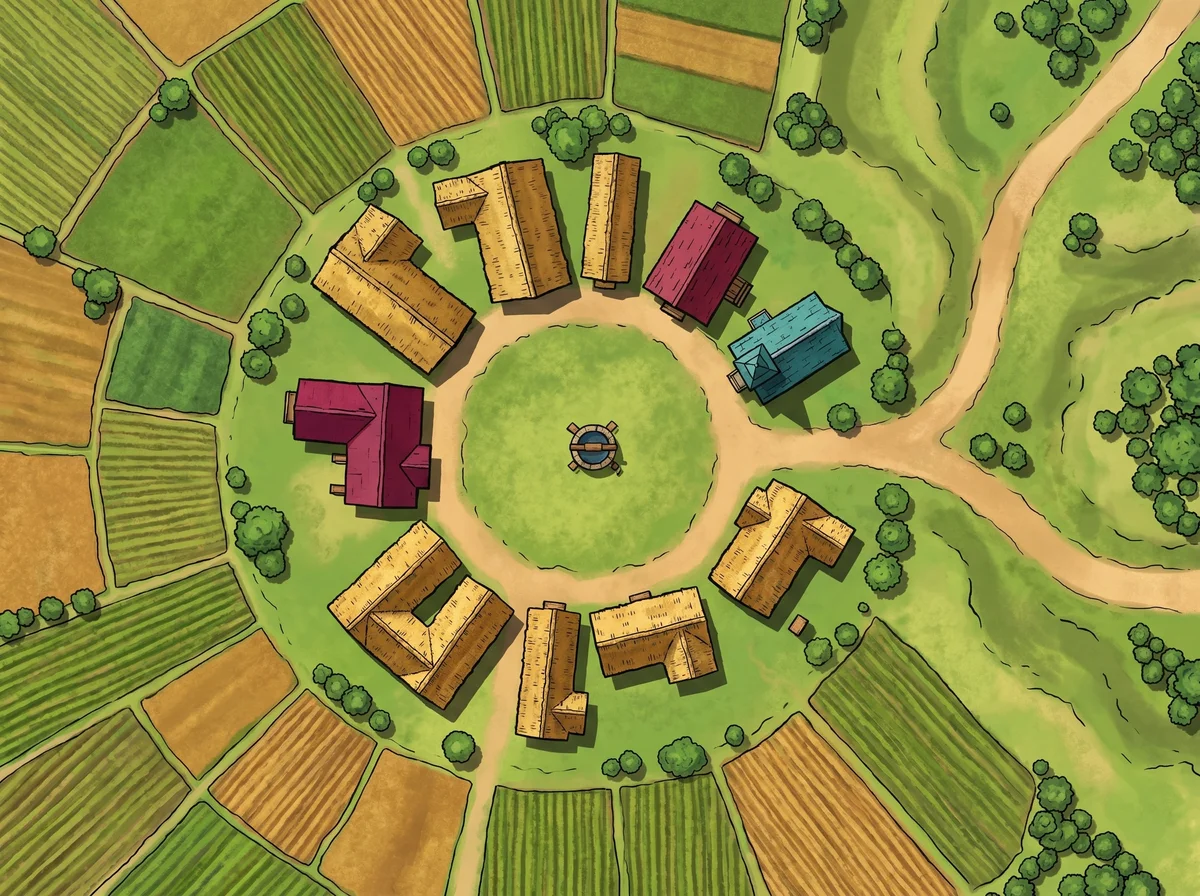 A village that does its job: 5 landmarks, one road in, one road out. Players interact with what matters and move on.
The Uncomfortable Truth
Most DMs over-prep towns because they're anxious about being caught unprepared. I know because I did it for years. The fear is: "What if my players ask about a building I didn't detail?"
The answer is: improvise. Say "it's a cooper's workshop" and move on. Your players won't remember the cooper. They'll remember the lighthouse with the ghost, or the NPC who lied about the missing shipment, or the tavern where Marcus arm-wrestled a dwarf for information.
Matt Colville makes this point in his Running the Game series: the details that matter are the ones attached to player decisions. Everything else is set dressing. And set dressing doesn't need to be on the map.
A village with 5 landmarks and one good secret will outperform a village with 50 buildings and no secrets. Every time.
Stop drawing buildings. Start hiding secrets.
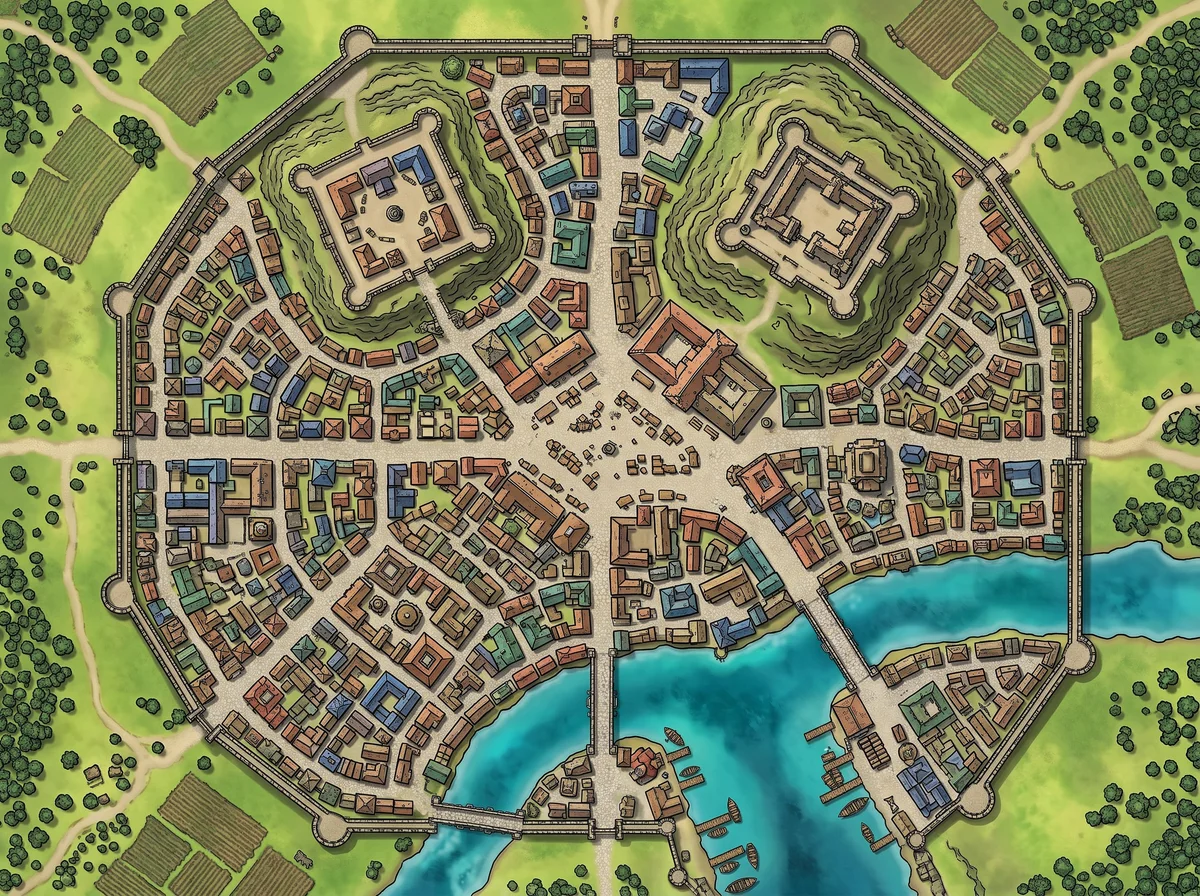 A city earns its density — every district has a function. A village that looks like this at the table will overwhelm rather than invite.
Related Reading
- How One D&D City Map Took Over 12 Sessions — When a town grows into a city mid-campaign.
- Fantasy City Map Generator — City-scale design principles.
- The 7 Questions I Answer Before Drawing a World Map — Deciding which settlements matter before you map them.
- Why Your Fantasy World Feels Small — When every town feels the same size, the world shrinks.
- DnD Village Maps: 4 Buildings That Make a Village Feel Alive — The village end of the scale spectrum.
- City Map Generator — Generate town and city maps at any scale.

Written by
Toby
Indie Developer & Creator of FantasyGen
Toby is an independent developer focused on building AI-powered creative tools. He created FantasyGen to help game masters and worldbuilders generate fantasy maps instantly — no artistic skills required.
Continue the Campaign
5 Districts Every Fantasy City Map Needs (and 2 I Forget)
After mapping 15 cities across 3 campaigns, I always start with the same 5 districts. The 2 I forget — undercity and tent slums — end up mattering most.
How to Stock a Hex Crawl With 12 Cities in Under an Hour
A step-by-step workflow for stocking a hex crawl with 12 cities using a random city generator. I prepped the entire Shattered Coast map in 45 minutes flat.
How One D&D City Map Took Over 12 Sessions of My Campaign
I prepped 4 districts for a throwaway port city. Three months later my players refused to leave. How one D&D city map became the center of my entire campaign.