

Hex vs Square Grid: When to Use Which (and Why I Switched)
I ran square grids for 200 sessions. Here's the hex grid map maker comparison that convinced me to switch, covering movement, aesthetics, and tool support.
For the first 200 of my 340 sessions, every map I made — dungeon, wilderness, city — sat on a square grid. Squares were the default in Roll20, the default in Foundry VTT, and the only hex grid map maker I'd heard of was Hexographer, which looked like it came from 2003. So I defaulted to squares for everything.
Then Justin Alexander's hexcrawl essays on The Alexandrian changed my mind. I spent 2 weeks converting an entire overworld to hex tiles. Haven't used squares for overland travel since.
This is the hex grid map maker comparison I wish I'd read before that conversion — covering movement math, aesthetics, tool support, and the one scenario where neither grid type works.
Square Grids Aren't Wrong — They're Just Not Universal
Most D&D players learn combat on a square grid. The Player's Handbook assumes it. Every VTT defaults to it. After 340 sessions, I can count squares in my sleep.
But square grids have a directional bias that most DMs never think about.
Moving diagonally on a square grid is either the same distance as moving cardinally (which is geometrically wrong — diagonal should be ~1.41x farther) or you apply the DMG's alternating 5-10-5-10 rule (correct but painful to track mid-combat). Neither option is great. The first is inaccurate. The second breaks flow.
Hex grids eliminate this entirely. Six equidistant directions. No diagonal penalty. No alternating-distance house rules. Every adjacent hex is the exact same distance from center, regardless of direction.
That alone doesn't make hex the winner everywhere.
The Head-to-Head: Hex Grid Map Maker Comparison
I built this table after running all three grid types across different encounter types over 8 years. The scoring is personal experience — at least 10+ sessions with each setup.
| Factor | Square Grid | Hex Grid | Gridless |
|---|---|---|---|
| Movement fairness | Diagonal distortion (1.41x vs 1.0x) unless using DMG alternating rule | 6 equidistant directions — no diagonal problem | N/A — theater of the mind |
| Room/building fit | Rooms map naturally to rectangles | Awkward for indoor spaces — hexes don't tile into clean walls | No mapping needed |
| Overworld travel | 4 cardinal + 4 diagonal directions feel arbitrary across natural terrain | 6-direction compass rose matches natural exploration beautifully | Works if players don't need precision |
| Tool support | Universal — Roll20, Foundry VTT, Inkarnate, every VTT | Growing — Foundry has hex toggle, Worldographer and dedicated hex map creators exist | No tool needed |
| Player learning curve | Zero — most players already know square grids | 5-10 minutes of orientation for new players | Tactical players resist it |
| Aesthetics | Clean for man-made structures, sterile for nature | Organic for landscapes — biome boundaries look lush | — |
| Range measurement | Easy: count squares, multiply by 5 | Easy: count hexes, multiply by hex scale | "About 30 feet away" — imprecise |
The pattern is clear once you lay it out: square grids are architecture grids — designed for rooms, corridors, cities, and structures with straight walls. Hex grids are nature grids — designed for terrain, coastlines, forests, and biome transitions where nothing runs in straight lines.
Gridless is a special case. I tried it for 3 sessions and my group rejected it. Tactical players want countable distances, and mine are definitely tactical.
When to Use Each Grid
Dungeons, Buildings, and Indoor Combat → Square
If the encounter has walls, use squares. Period.
Rooms are rectangular. Corridors run straight or turn at right angles. Doors sit in walls at 90 degrees. Mapping a dungeon onto hex tiles is like tiling a bathroom floor with pentagons — technically creative, practically miserable. I've seen DMs try it on r/DMAcademy. Every thread ends with "I switched back to square."
Every dungeon in my Shattered Coast campaign — 47 sessions and counting — uses a square grid at 5-foot scale. The battle map generator I use outputs square-grid tactical maps for this exact reason: architecture is rectangular, and D&D's combat math assumes it.
Even dedicated hex map generator tools don't pretend hex works for indoor combat. They know.
Overworld, Exploration, and Sandbox Campaigns → Hex
The moment players step outdoors and start traveling between locations, hex wins decisively.
A hex-based overworld with 6-mile hexes does three things that square grids structurally cannot:
- Uniform travel distance in every direction. Players moving north or northwest cover the same ground per hex. No more "does diagonal cost 1 or 1.5?" arguments at the table. I had that exact argument with Marcus at session 9 of my second campaign — and I didn't have a consistent answer.
- Natural terrain boundaries. Hex edges follow coastlines and forest borders without the staircase aliasing that plagues square grids. Mountains don't have right-angle edges in nature, and they shouldn't on your map.
- Structured exploration pacing. One hex = one discrete unit of discovery. Justin Alexander's hexcrawl framework builds on this principle: each hex contains one keyed encounter or landmark, creating predictable travel rhythm for both DM and players.
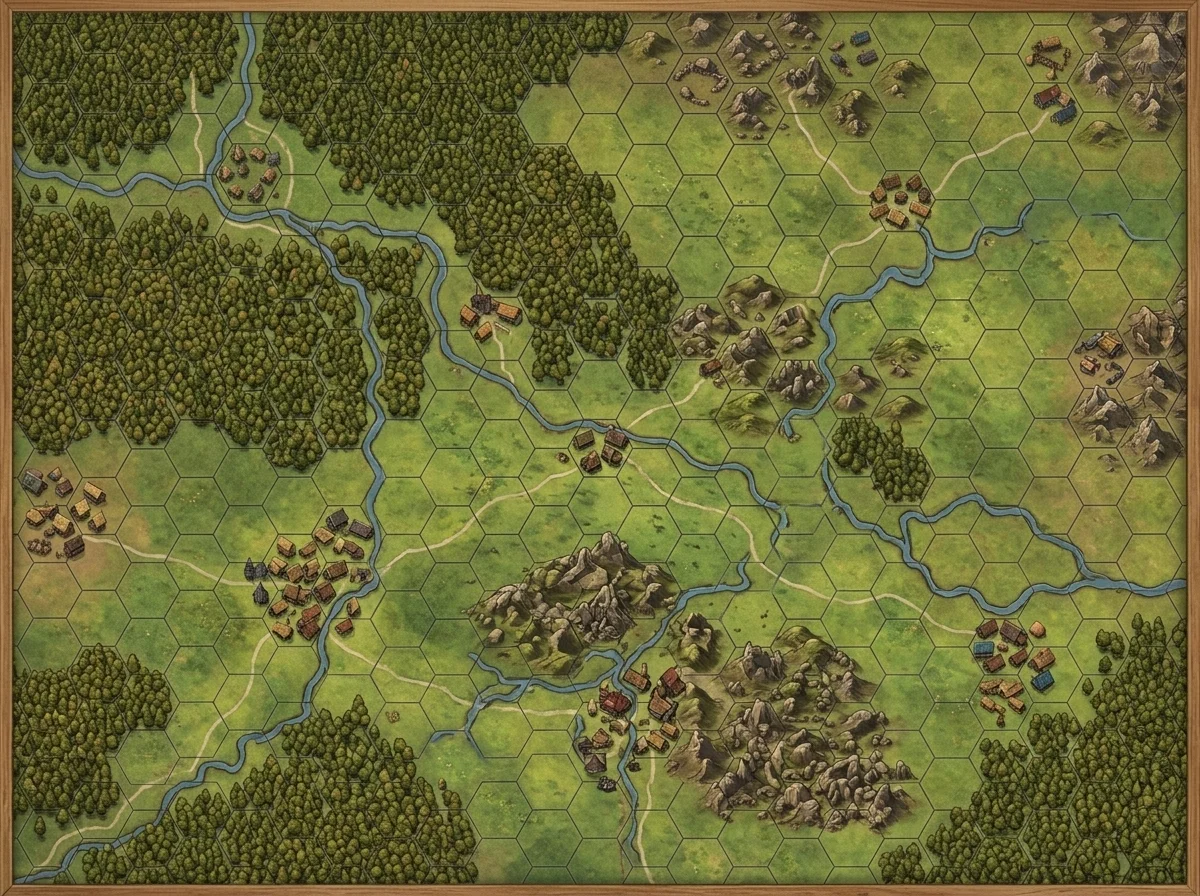 A hex overworld generated with the hex map generator — each hex represents one keyed exploration unit with a single encounter or landmark.
I build all my overworld maps with a hex map maker now. The first one took 15 minutes to learn. Every map since has looked more organic than anything I spent 3 hours hand-drawing in Inkarnate.
Narrative/Social Scenes → Gridless (Sparingly)
I only go gridless when positioning genuinely doesn't matter — a throne room negotiation, a campfire conversation, a skill-based chase resolved with Athletics rolls rather than movement counting.
The r/DMAcademy community leans the same direction. Most threads about removing the grid end with "we tried it and went back." My Wednesday group would riot if I took their squares away during combat.
Why I Switched (The Actual Story)
Here's what happened.
My first 2 campaigns — roughly 200 sessions — used square grids for everything. Overworld maps included. I had my second campaign's continent on a 30×30 grid, each square representing about 20 miles. Travel worked, sort of. But every time the party wanted to go northeast toward a mountain range, I had to improvise whether diagonal movement cost 1 square or 1.5 squares.
I wasn't consistent. My players noticed. Marcus flat-out asked "does diagonal cost extra?" at session 9, and I stumbled through a non-answer.
A thread on r/DMAcademy linked me to The Alexandrian's hexcrawl design series. I read all 5 parts in one sitting on a Sunday afternoon. The following weekend, I regenerated my overworld as a hex map and overlaid the same geography onto hex tiles. The conversion took about 40 minutes — mostly re-keying encounter locations into the new grid.
The difference was immediate.
Travel became predictable. "It's 3 hexes to the capital" meant the same distance regardless of compass direction. Terrain boundaries looked organic instead of stair-stepped. And the encounter-keying system — one discovery per hex — gave me a structured way to stock the overworld without over-prepping 40 locations or under-prepping and improvising everything.
When I started the Shattered Coast campaign, hex was the obvious choice from session 1. I prepped 12 settlements across the hex map in 45 minutes. Combat still runs on square grids. The two systems coexist perfectly — hex for travel, square for fighting.
I hadn't been using squares for overworld because I'd weighed the options. I used them because inertia told me to.
The Winner by Use Case
| Encounter Type | Best Grid | Why |
|---|---|---|
| Dungeon / indoor combat | Square | Walls are rectangular; 5-ft grid matches D&D combat math |
| Overworld travel / hexcrawl | Hex | Uniform distance; natural terrain edges; keyed exploration |
| Large outdoor combat (10+ creatures) | Hex | Open terrain benefits from 6-direction movement — no diagonal tax |
| Small outdoor combat (<10 creatures) | Square | Simpler; players are already familiar; fewer tokens to track |
| Chase scene / pursuit | Square at 30-ft scale | Long narrow maps suit rectangular grids |
| Ship / naval combat | Square | Ship decks are rectangular structures |
| Sandbox campaign world | Hex | Keyed hexes = structured exploration at campaign scale |
| Narrative / social | Gridless | Positioning doesn't matter — save the grid for when it does |
My Hex Grid Map Maker Setup
Here's what I actually use now.
Every hex overworld starts with FantasyGen's hex map generator. I describe the terrain and biomes, and get a complete hex map back in under 60 seconds. For individual encounter maps within those hexes — a bandit camp, a ruined shrine, a forest clearing — I switch to the square-grid battle map generator, because at combat zoom, squares win again.
This two-grid workflow replaced my old system: Inkarnate for overworld ($25/year, no hex support, 2-3 hours per map) plus a hand-written hex key in Notion that I lost once during a sync error. Two tools now, one for each grid type, each doing what it does best.
If you want the full step-by-step process — from hex overworld to keyed encounters to session prep — I walk through the entire workflow in my hex map maker campaign post.
Your grid isn't decoration. It's a design decision that shapes how travel, combat, and exploration feel at the table. Pick the wrong one, and your players spend more time arguing geometry than playing the game.
Try hex for your next overworld. Give it 3 sessions. I've run 140 sessions since switching, and not once has a player asked "does diagonal cost extra?"
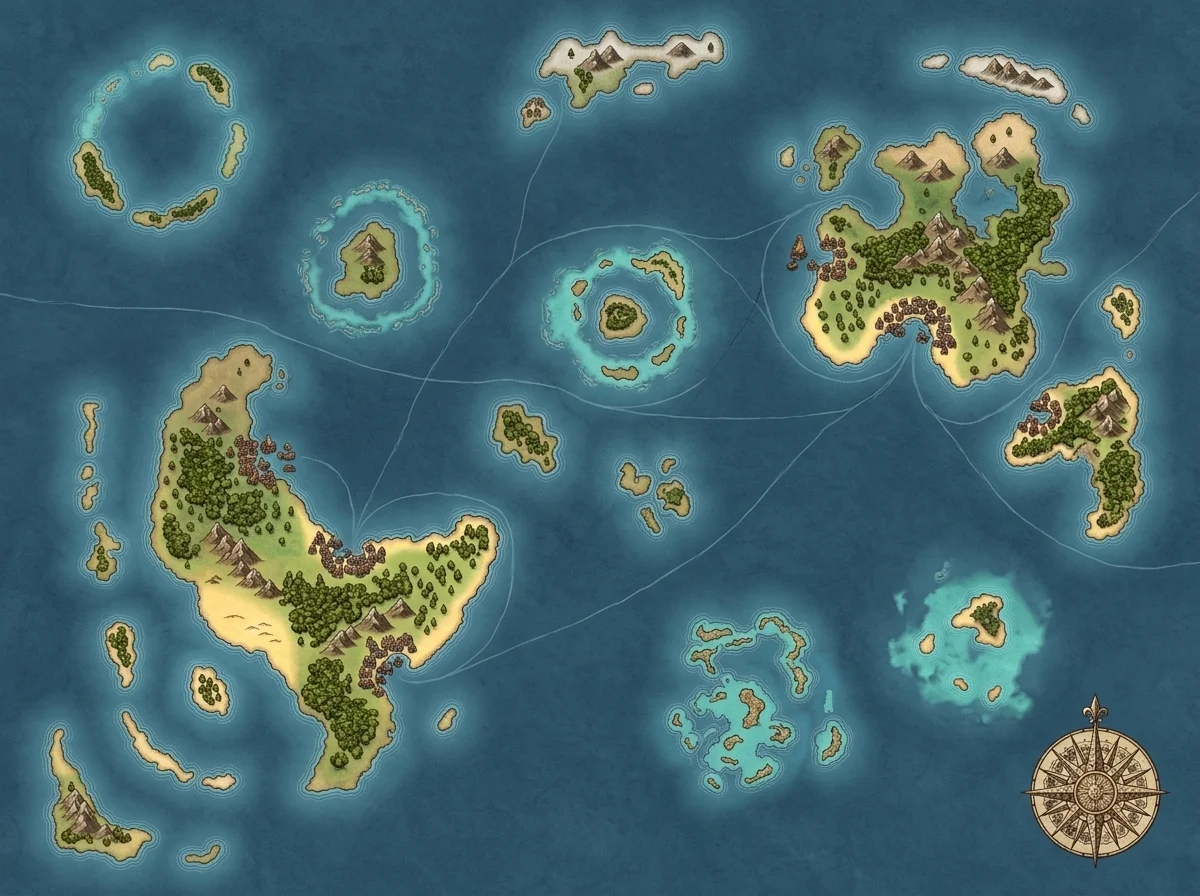 An archipelago hex map — island-hopping campaigns where travel direction matters are hex grid territory.
Related Reading
- D&D Map Scale: When I Stopped Using the 5-Foot Grid — Choosing the right scale within your chosen grid type.
- Hex Map Generator — Generate hex-based overworld maps for sandbox campaigns.
- How to Stock a Hex Crawl With 12 Cities — Filling your hex map with settlements and encounters.

Written by
Toby
Indie Developer & Creator of FantasyGen
Toby is an independent developer focused on building AI-powered creative tools. He created FantasyGen to help game masters and worldbuilders generate fantasy maps instantly — no artistic skills required.
Continue the Campaign
How to Fill a Hex Map Without Burning Out After 20 Hexes
I burned out after hand-filling 20 hex map tiles. These 5 DM-tested rules keep hexcrawl prep sustainable — most hexes end up filling themselves at the table.
Hex Map Maker Workflow: From Blank Grid to 6-Session Campaign
I built a 6-session hexcrawl sandbox with a hex map maker in 45 minutes flat. Here's the exact step-by-step workflow from blank hex grid to campaign day one.
How to Map a Cave System Without Getting Lost in Your Own Design
My 5-step workflow for designing cave map systems that stay playable. Start with entrance type, limit branches, add landmarks, loop dead ends — no spaghetti.