
D&D Map Scale: When I Stopped Using the 5-Foot Grid
Why the standard 5-foot grid doesn't fit every D&D encounter — and the 3 alternative scales I use for wilderness, chase scenes, and city exploration.
For 3 years, every map I made used 1 square = 5 feet. Dungeon? 5-foot grid. Forest? 5-foot grid. City chase scene through 8 city blocks? 5-foot grid, which meant either a comically large map or a comically small chase.
The 5-foot grid is a brilliant default for room-to-room dungeon combat. It's terrible for everything else. Once I started using 3 different scales for 3 different encounter types, my games immediately felt more dynamic.
The Problem with One Scale
The 5-foot grid assumes:
- Encounters happen in enclosed spaces (rooms, corridors)
- Movement ranges are 20-40 feet per turn
- The entire battlefield fits on a reasonable surface (25×25 squares = 125×125 feet)
These assumptions hold for dungeon crawls. They break for:
Wilderness ambushes: a forest clearing might be 200 feet across. At 5-foot scale, that's a 40×40 grid — too large for most tables and VTT screens. Players at the edges can't reach combat for 3 rounds.
Chase scenes: a chase through city streets covers 300-500 feet. At 5-foot scale, you'd need a map 60-100 squares long. Nobody prints that.
Naval combat: ship-to-ship engagement happens at 200-600 feet. A 5-foot grid makes ships look like they're docked side by side.
Large-scale battles: 50 creatures on a battlefield need room to maneuver. A 5-foot grid with 50 tokens is visual chaos.
Scale 1: The Standard (1 sq = 5 ft)
Use for: dungeon rooms, tavern brawls, small outdoor encounters, any combat where movement is measured in 5-foot increments.
This is the scale the Player's Handbook assumes. Miniatures fit cleanly. Spell ranges (30 ft Fireball, 60 ft ranged attacks) translate directly to countable squares. It works because D&D's combat system was designed around it.
My map size at this scale: 25×25 squares (125×125 ft). Covers 90% of indoor encounters.
I generate these maps with the D&D map generator at default settings. The battle map generator also defaults to this scale.
Scale 2: The Tactical Zoom-Out (1 sq = 10 ft)
Use for: large outdoor encounters, multi-group combat, wilderness ambushes.
At this scale, a 25×25 grid covers 250×250 feet — an entire forest clearing, a wide beach, or a village square. Movement speed effectively halves in squares (30 ft = 3 squares), which makes positioning more decisive. You commit to a position because repositioning costs proportionally more.
What changes mechanically:
- Movement: 30 ft = 3 squares (not 6)
- Spell ranges feel shorter relative to the map — Fireball's 20-ft radius covers fewer squares
- Ranged characters become more valuable (they still hit at 120+ ft)
- The battlefield feels more like a war than a skirmish
When I discovered this: session 31 of the Shattered Coast. The party fought 15 bandits in a forest clearing. At 5-foot scale, I needed a 50×50 grid to fit everyone. I switched to 10-foot squares on the fly, shrunk the map to 25×25, and the encounter played better — more tactical movement, less crowding.
My prompt adjustment: I generate the same maps but tell players "each square is 10 feet." No map changes needed — just scale interpretation.
Scale 3: The Chase/Travel Scale (1 sq = 30 ft)
Use for: chase scenes, moving encounters, anything where the goal is distance covered rather than position held.
At 30-foot scale, a 25×25 grid covers 750×750 feet — roughly 2.5 city blocks. A character with 30 ft movement speed moves 1 square per turn. Dashing moves 2.
What changes mechanically:
- Sprint dynamics matter: characters with 35+ ft speed gain a meaningful edge (they can outpace 30-ft characters by 1 square every 6 rounds)
- Obstacles occupy single squares: a market stall, a cart, a crowd — each is 1 square of difficult terrain
- The map scrolls: I prep a map that's 50 squares long and reveal it in 25-square windows as the chase progresses
- Spell ranges become area-denial: Grease covers 1 square at this scale but blocks the entire street
When I use this: rooftop chases, city pursuits, horse-mounted encounters. The 5 battle map themes post mentions rooftop chases as one of my recurring encounter types — this is the scale I run them at.
How to Choose
Is the encounter in a building or small area? → 5 ft grid
Is the encounter outdoors with >10 creatures? → 10 ft grid
Is the encounter about movement/pursuit? → 30 ft grid
That's the entire decision tree. I don't stress over edge cases. If an encounter starts at one scale and shifts (the dungeon fight spills out into the courtyard), I either re-describe positions verbally or switch to theater of the mind for the transition.
The Scale I Don't Use: Abstract
Some DMs go fully abstract — no grid, no measurements, just relative positioning ("you're close to the ogre, the wizard is far back"). I tried this for 3 sessions. My players hated it. They wanted to count squares and calculate ranges. The grid gives tactical players a framework for decision-making.
Keith Ammann's The Monsters Know What They Do assumes gridded combat for all tactical analysis. If you're running intelligent enemies that use terrain, you need a scale that makes terrain countable.
But theater of the mind has its place — for social scenes, exploration, and any moment where the story matters more than the positions. I just don't use it for combat.
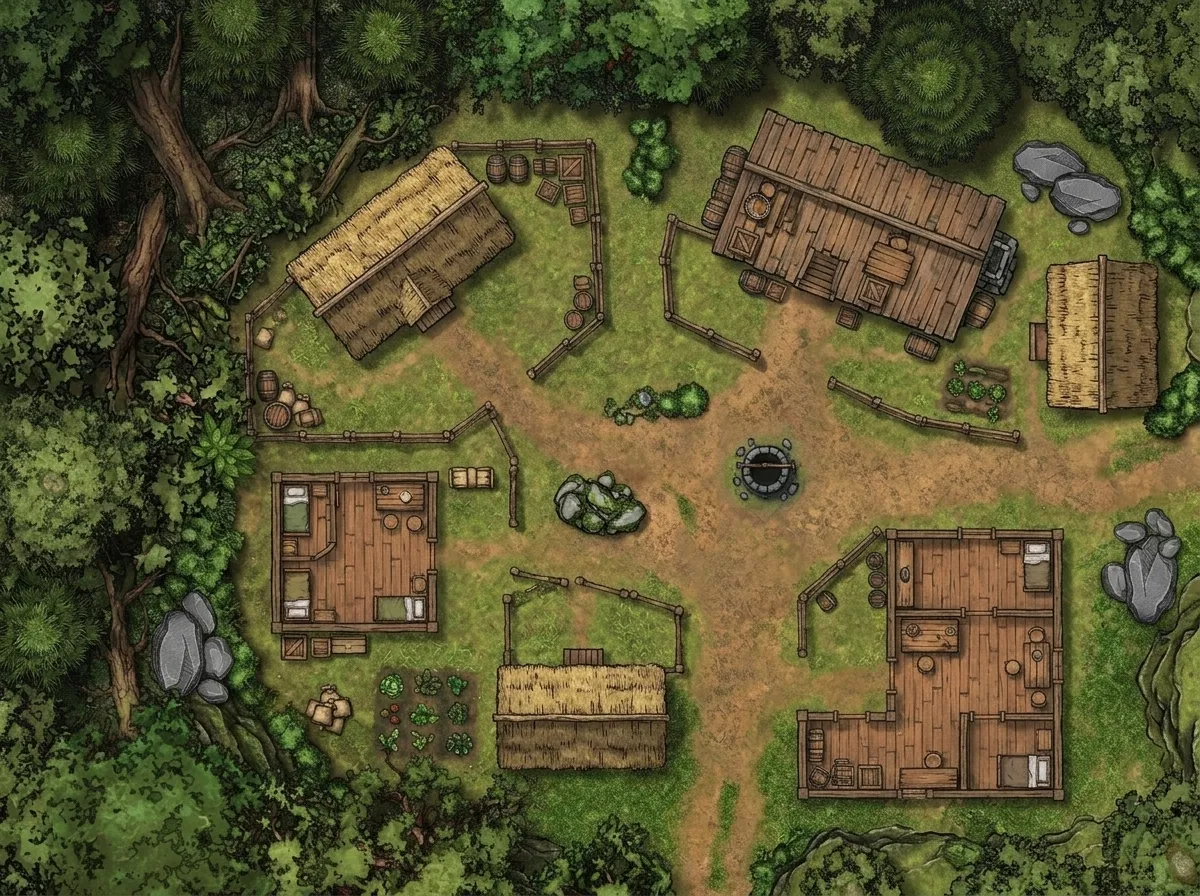 A forest clearing at 10-foot scale — the wider view gives room for 15+ creatures without overcrowding. Same map, different interpretation.
What This Means for Map Generation
When I generate maps, I don't change anything about the image based on scale. A 25×25 image works at any scale — the grid overlay and scale interpretation are separate from the art.
The change is in the prompt: for 10-ft scale encounters, I describe a wider area in the prompt ("forest clearing 250 feet across with a stream"). For 30-ft chase maps, I describe a long, narrow area ("city street extending three blocks with market stalls and alleys").
The art adjusts to the description. The scale is in your head, not in the pixels.
Use the 5-foot grid when it works. Throw it out when it doesn't.
Your chase scenes will be faster, your wilderness encounters will breathe, and your players will stop asking "wait, are we supposed to be 200 feet apart?"
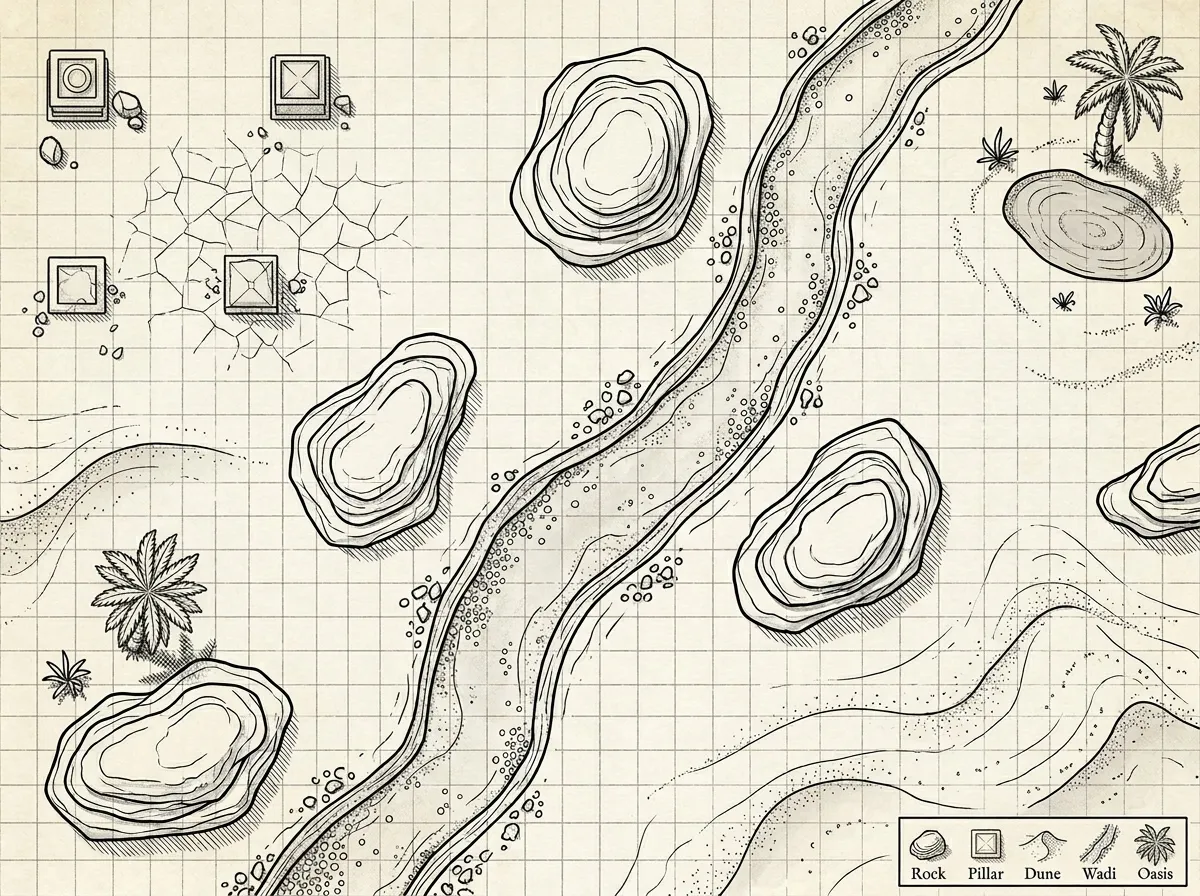 A desert ruins encounter at 10-foot scale — at standard 5-foot, this encounter would need a 50×50 grid. At 10-foot, it fits on a standard 25×25 map.
Related Reading
- How to Print Battle Maps at 1-Inch Grid Scale — Printing at correct scale regardless of grid size.
- 3 Battle Map Mistakes I Made for 4 Years Straight — Scale is mistake #0 — the one I didn't even know I was making.
- DnD Map Generator Workflow — How I generate maps at any scale.
- D&D Map Generator — Generate maps for all three scales.
- Battle Map Generator — Tactical-specific maps.
- Hex vs Square Grid: When to Use Which — The grid debate extended beyond 5-ft squares to hex exploration.

Written by
Toby
Indie Developer & Creator of FantasyGen
Toby is an independent developer focused on building AI-powered creative tools. He created FantasyGen to help game masters and worldbuilders generate fantasy maps instantly — no artistic skills required.
Continue the Campaign
5 Battle Map Themes I Reuse Every Campaign
The 5 battle map environments I prep once and reuse across every D&D campaign — forest road, tavern brawl, bridge crossing, cave ambush, and rooftop chase.
How to Print Battle Maps That Actually Align to a 1-Inch Grid
The step-by-step workflow I use to print AI-generated battle maps at perfect 1-inch grid scale for miniatures. Covers home printers, poster prints, and common alignment fixes.
Choke Points, Cover, and Why Most Battle Maps Are Flat
Why D&D battle maps feel tactically empty and how three terrain features — choke points, cover, and elevation — fix combat in under 60 seconds of map prep.