
How to Map a Cave System Without Getting Lost in Your Own Design
My 5-step workflow for designing cave map systems that stay playable. Start with entrance type, limit branches, add landmarks, loop dead ends — no spaghetti.
Session 24 of The Shattered Coast. My players descended into a cave system I'd prepped for 3 hours — 14 chambers, 9 branching tunnels, 2 underground rivers, and a vertical shaft I was particularly proud of. By hour two at the table, Marcus's fighter was standing at a 5-way junction asking "wait, which tunnel did we already check?" for the fourth time.
That cave map was gorgeous. It was also completely unplayable.
I've run 18 underground sessions across 3 campaigns since then, and the lesson is always the same: cave systems don't fail because they're too simple. They fail because the DM got lost in their own design before the players ever could.
Most DM advice says to sketch the whole cave first — draw the shape, then fill in details. That's backwards. Start with the entrance. Design outward from there. Mike Shea at Sly Flourish talks about building situations, not plots — I'd extend that to cave map design. Build from the point of entry, not from the boss chamber. The entrance determines tone, pacing, and the party's first decision.
Here's the 5-step workflow I use now. Every step exists because I broke the rule at least once.
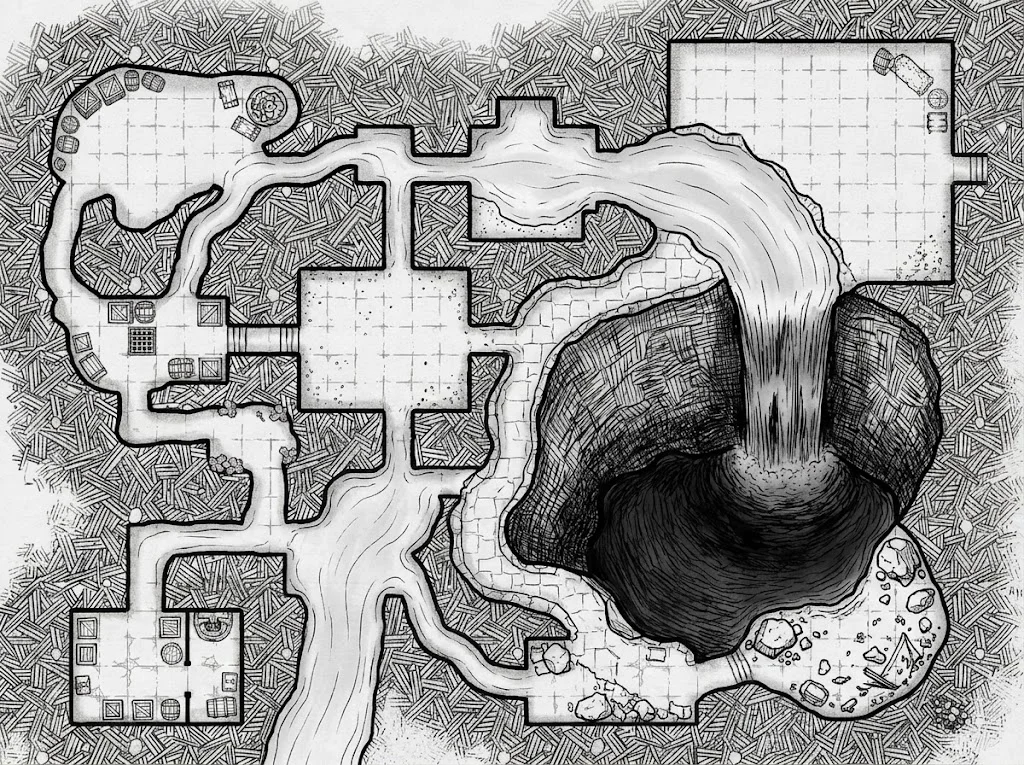
Step 1: Pick Your Entrance Type First
Every cave map in D&D starts with one question: how do the players get in? This isn't flavor. The entrance type constrains everything that follows.
Wide mouth — a 20-foot opening, visible from the road. Daylight reaches 60 feet inside. Players walk in formation, fighter up front, rogue checking for traps. Wide mouths work best when the threat escalates gradually — let the first 2-3 rooms feel deceptively safe.
Hidden crack — a 3-foot gap behind a waterfall, a narrow fissure in a cliff face. Players enter single-file. Heavy armor is a problem. The fighter goes last. If enemies attack before the whole party squeezes through, you've got a split-party situation — brilliant or catastrophic depending on your prep.
Underwater entry — players swim through a flooded passage for 30-60 feet before surfacing in an air pocket. Torches are out. Equipment checks matter. I've used underwater entries twice. The first time created the most tense 10 minutes of my campaign. The second time, I forgot 2 players had heavy armor and the entry nearly became a TPK before the cave even started.
The rule: pick one entrance type and let it dictate your first 3 rooms. Don't decide the entrance after you've designed the cave — design the cave after you've decided the entrance.
Step 2: The Cave Map Branch Rule — Max 3 Paths at Any Junction
This is the rule that saved my dnd cave map prep from becoming unusable.
At any junction, players should face no more than 3 choices. Left, right, or down. Forward, side passage, or back. More than 3 and players stall. I've watched my Wednesday group freeze at a 5-way junction at least 6 times — a 3-hour session turns into a 40-minute argument about which passage to explore first.
A r/DMAcademy discussion on cave crawl pacing confirmed what I'd already suspected: DMs reporting "my players got bored in the caves" were consistently running systems with 4+ branches per node. The ones running tight 2-3 branch systems had the opposite problem — players didn't want to leave.
Practical tip: when I use a cave map generator and the output shows a hub room with 5 exits, I close 2 of them. Collapsed rubble, flooded passage, too narrow for Medium creatures — whatever makes narrative sense. The map gets better every time I subtract.
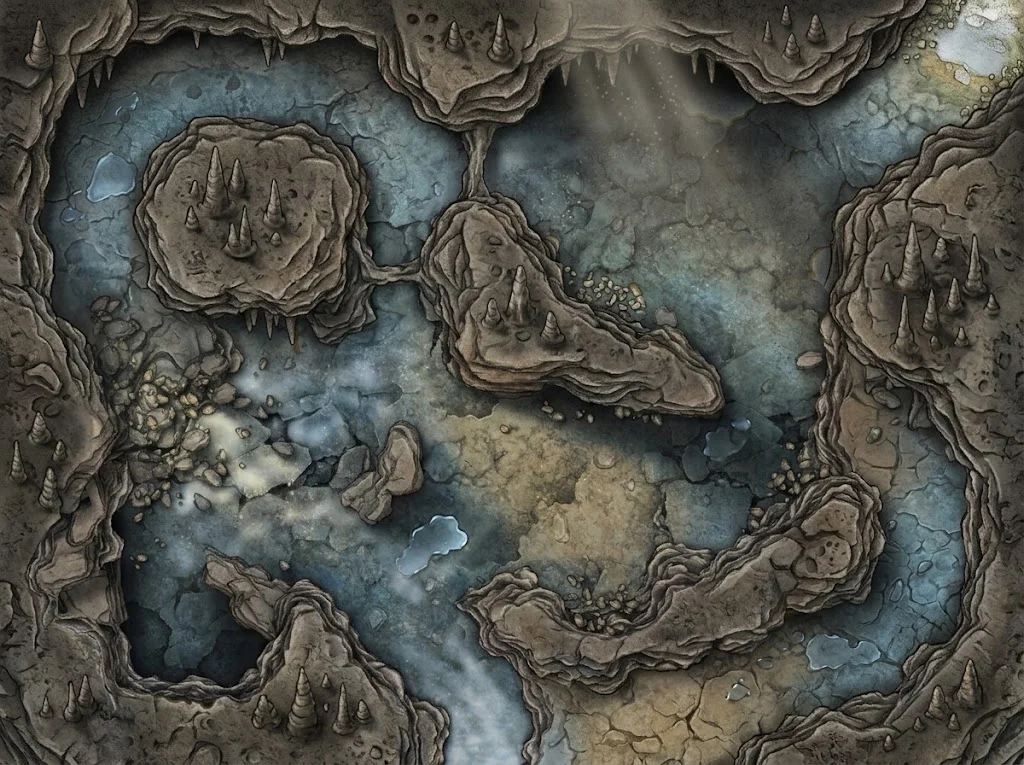 Generated with "natural cave system, branching tunnels, underground pools, crystal formations, top-down" — then two exits collapsed in post-edit.
Step 3: Drop a Landmark Every 2-3 Rooms
Players in a cave don't have street signs. They need landmarks.
I place one distinctive feature every 2-3 rooms: a stalactite formation shaped like a claw, an underground pool with bioluminescent fungi, a collapsed section where the ceiling dropped, a vein of quartz running through the west wall. These aren't decorative. They're navigational anchors. When a player says "I want to go back to the room with the glowing pool," everyone at the table knows exactly where that is. When they say "I want to go back to... the second left turn after the third passage?" — that's when sessions die.
Landmarks also help you. I once ran a 12-room cave with no distinctive features and mixed up which tunnel led to the boss chamber and which led to the treasure vault. My players fought the boss with half their resources because I sent them the wrong way.
The ratio: 1 landmark per 2-3 rooms. Not every room needs one. But if players go 4 rooms without seeing something distinctive, you've lost them.
Step 4: Loop Your Dead Ends Back
Linear caves are boring. Pure branching caves are confusing.
The answer is loops.
Every dead end connects back to a room the players have already visited — through a crawl space, a vertical shaft, a collapsed wall, or a flooded passage that drains into a familiar chamber. Players take the left tunnel, explore 3 rooms, and emerge from a side passage in a chamber they passed through 20 minutes ago. Suddenly the cave feels like a real geological system instead of a flowchart.
My ratio: for every 4-5 rooms, at least 1 loop connection. A 12-room cave should have 2-3 loops minimum. For more on how underground layouts shape cave encounters, I wrote a separate breakdown — but the core principle is: loops create tactical options. If players are retreating, a loop lets them circle around and set an ambush instead of forcing a binary fight-or-flee decision. Dead ends with no loops make every cave battlemap feel flat.
Step 5: Generate Your DnD Cave Map and Iterate
I don't draw my cave maps from scratch anymore. I haven't for 14 months.
My workflow: type a prompt into FantasyGen's cave map generator, get a result in 45-60 seconds, then apply the 4 rules above as a checklist. Too many exits? Close them. No landmarks in the southern section? Add a collapsed column. No loops? Connect two dead ends with a flooded crawlspace.
The generator handles geology. I handle playability.
This takes me 8-12 minutes per cave map, down from 90 minutes when I hand-drew cave systems in Inkarnate. Cave maps need more iteration than dungeon maps — natural cave systems are irregular, and irregular spaces are harder to make navigable. I generate 2-3 variants and pick the one where entrance, branching, landmarks, and loops align best.
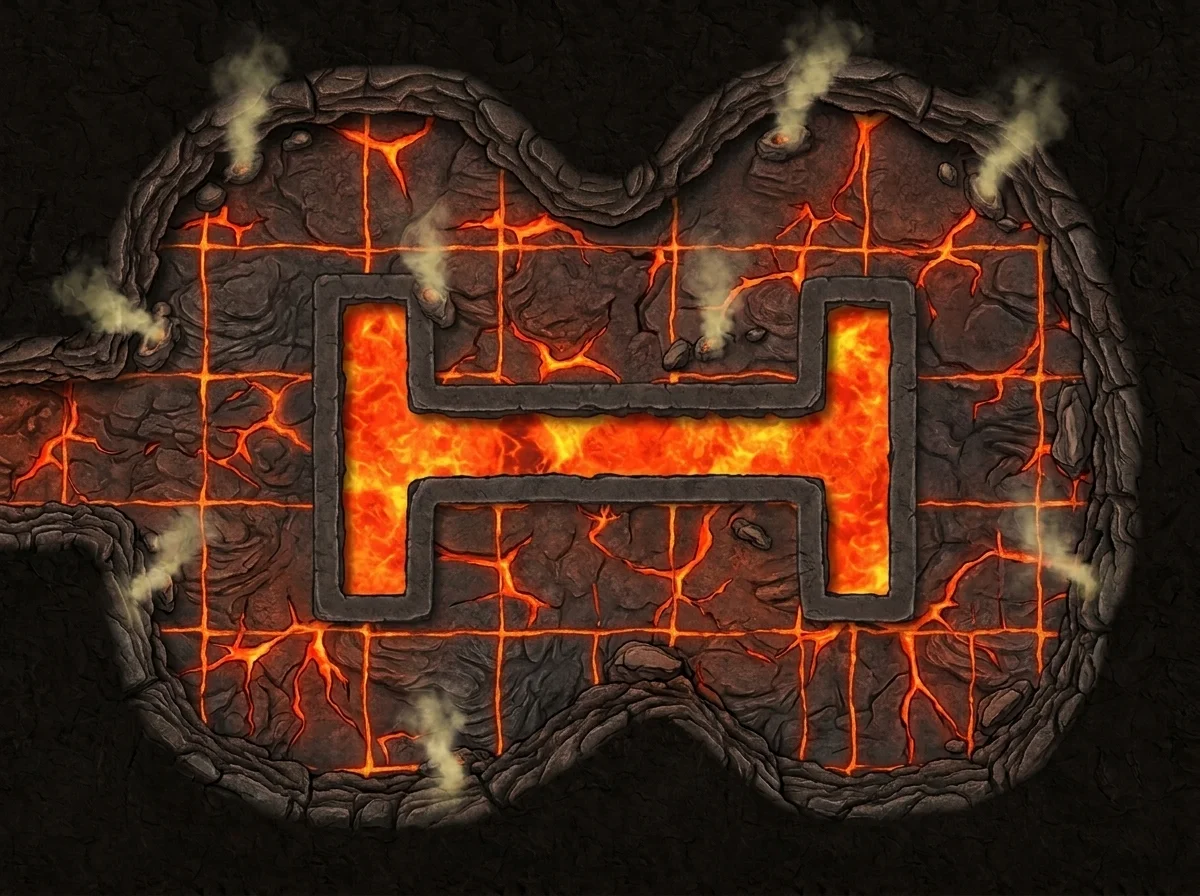 "Volcanic lava tubes, magma channels, obsidian formations, top-down cave map" — the branching on this one needed zero edits.
Cave Systems That Got Too Complex
I've broken every rule in this post at least once. Here's what that cost me.
-
The 14-Room Spiderweb. Session 24 — the one I opened with. Fourteen chambers, 9 branching paths, no landmarks, no loops. My players spent more time navigating than roleplaying. Jess literally said "I don't know where I am" — not her character, her. I scrapped the bottom 6 rooms mid-session and no one noticed.
-
The Underwater Nightmare. A cave battlemap where every other room was flooded. Cool in theory. In practice, players tracked breath timers, movement penalties, and equipment conditions for every transition. I was rolling more bookkeeping checks than combat rolls. Two underwater rooms max per cave system. I mean it.
-
The Boss Chamber with No Retreat Path. Final encounter at the deepest dead end, zero loops back. The party nearly TPK'd — not from difficulty, but because they couldn't retreat and regroup. A boss chamber needs at least 2 exits. Always.
-
The "Realistic" Cave. I once tried to make a geologically accurate cave system — proper flowstone formations, water table logic, realistic passage widths. Five hours to design. My players didn't notice a single geological detail. They just wanted to know where the goblins were.
When This Workflow Doesn't Apply
-
Single-room caves. Boss lairs, ritual chambers, a dragon's den — these are arena encounters, not cave systems. Different design rules. Use a dnd cave map with one big space and focus on cover and terrain instead of navigation.
-
Megadungeons. Caves spanning 30+ rooms across multiple levels need faction maps, random encounter tables, and session-to-session tracking that goes well beyond this 5-step checklist.
-
Guide NPCs. If an NPC is leading the party through the cave, navigation ceases to matter. Skip landmark prep entirely and spend that time on encounter design.
CAVE MAP DESIGN — 5-STEP CHECKLIST
━━━━━━━━━━━━━━━━━━━━━━━━━━━━━━━━━━
1. ENTRANCE TYPE   → Wide mouth / hidden crack / underwater
                     Let it dictate your first 3 rooms

2. BRANCH LIMIT    → Max 3 paths at any junction
                     Close extra exits with rubble, water, or narrows

3. LANDMARKS       → 1 distinctive feature per 2-3 rooms
                     Players navigate by landmarks, not directions

4. LOOPS           → Connect dead ends back to visited rooms
                     1 loop per 4-5 rooms minimum

5. GENERATE + EDIT → AI generates geology, you enforce playability
                     2-3 variants, pick the cleanest layout
Your next cave doesn't need 14 rooms. It needs 6-8 rooms, 2 landmarks, 1 loop, and an entrance that sets the tone before the first torch is lit. Open the generator, type a prompt, and spend your time on the checklist — not on drawing stalactites.
The best cave map isn't the most complex one. It's the one where nobody asks "wait, where are we?" twice.
Related Reading
- How Underground Layouts Shape Cave Encounters — layout patterns for dnd cave maps that change how combat and exploration feel
- Tight Space Tactics for Cave Battlemaps — running combat in narrow passages without every fight becoming a corridor slugfest
- How to Prep a Dungeon in 20 Minutes — the same time-boxed prep approach applied to stone dungeons
- Dungeon Map Generator — for when your cave connects to a constructed dungeon

Written by
Toby
Indie Developer & Creator of FantasyGen
Toby is an independent developer focused on building AI-powered creative tools. He created FantasyGen to help game masters and worldbuilders generate fantasy maps instantly — no artistic skills required.
Continue the Campaign
Cave Battle Maps: Why Tight Spaces Create the Best Fights
Cave battle map design forces tactical decisions open maps avoid. Learn why tight corridors, darkness, and vertical drops create the most memorable D&D fights.
DnD Cave Maps: 3 Underground Layouts That Never Bore My Players
After 12 underground encounters, I keep returning to 3 dnd cave map layouts. Each uses terrain — water, light, exits — as a tactical weapon, not decoration.
Desert Encounters That Aren't Just Heat and Thirst
Desert encounter prep that goes beyond survival mechanics. Caravan politics, sandstorm puzzles, buried ruins, and creature lairs for your desert biome map.