
Desert Encounters That Aren't Just Heat and Thirst
Desert encounter prep that goes beyond survival mechanics. Caravan politics, sandstorm puzzles, buried ruins, and creature lairs for your desert biome map.
I've run 7 desert sessions across 2 campaigns. In 5 of them, the most memorable moment had nothing to do with water rations or exhaustion saves. It was a trade dispute at a desert oasis that escalated into a knife fight over well access. It was quicksand that separated the party for 40 minutes of real-time play. It was Dan's wizard accidentally activating a buried ward in a half-excavated temple and summoning something the group wasn't remotely ready for.
Heat and thirst are the wallpaper of a desert biome map. They set mood, but they don't create stories.
The encounters players remember are political, environmental, archaeological, and predatory. You can prep all four in under 30 minutes.
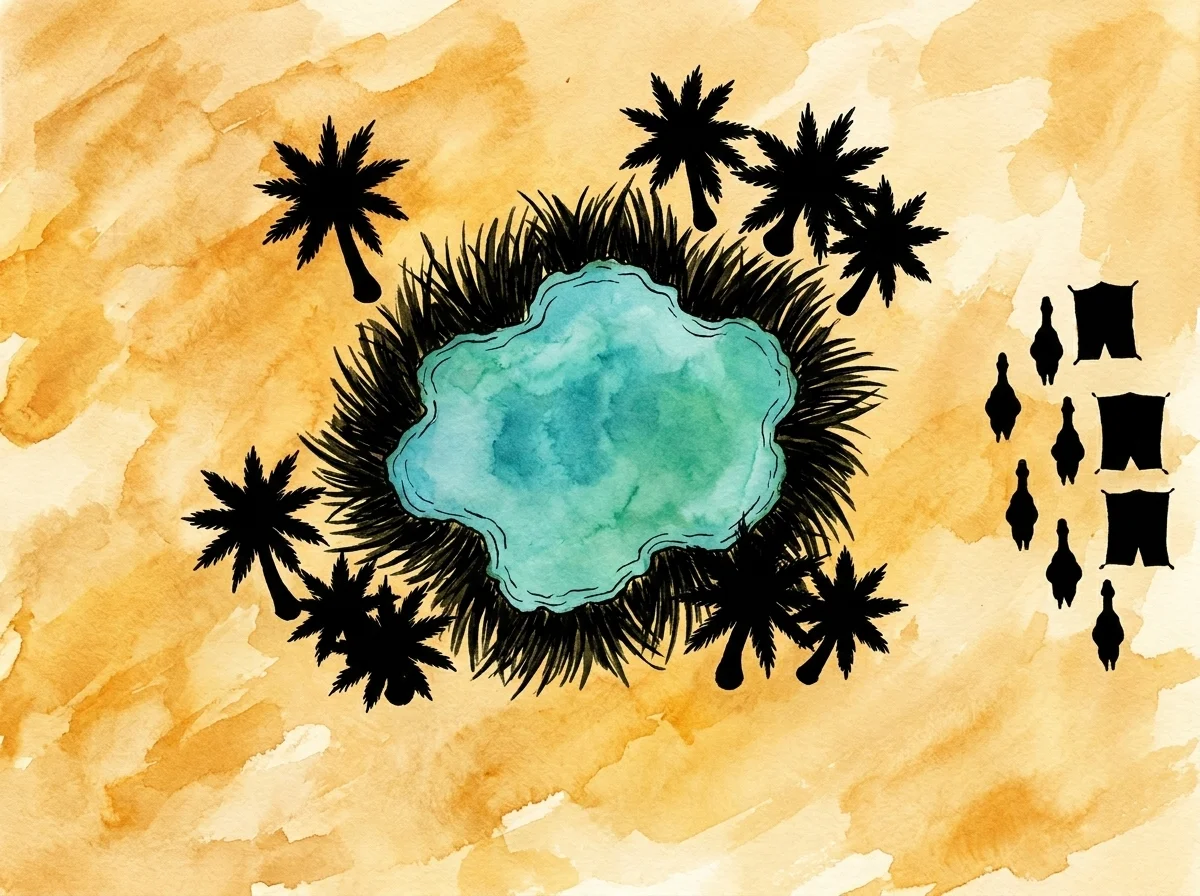
Why Your Desert Biome Map Needs More Than a Constitution Save
Most DMs run deserts as a survival gauntlet. Constitution saves against heat. Tracking water supply in ounces. Random encounters with scorpions. Mike Shea at Sly Flourish has written about how the best environments create encounters through friction between factions, not just environmental damage. Deserts do this naturally — every water source is contested, every trade route is political, every ruin is someone's ancestral claim.
The survival mechanics aren't wrong. They're just not enough.
A desert biome map with only heat and thirst is a hallway with a damage aura. One with trade routes, buried temples, territorial creatures, and sandstorm-exposed ruins is a sandbox — literally. Here's the 4-step workflow I use to prep encounters that go beyond "make a survival check."
Step 1: Layer in Political Encounters (10 Minutes)
Deserts concentrate power around water. Every oasis, every underground spring, every well is a political chokepoint — and that makes them perfect encounter fuel.
When I open the desert map generator, the first thing I mark isn't terrain. It's who controls what.
Caravan Politics
Trade caravans are mobile encounter engines. A caravan passing through disputed territory might need the party as escorts — not against monsters, but against the rival merchant house that's been sabotaging competitors' water supplies. In one of my Friday one-shot sessions, I ran a 3-faction caravan standoff at an oasis: the merchant guild, a nomadic clan claiming ancestral water rights, and a religious order that considered the spring sacred. The party had to negotiate, not fight. Jess's rogue thrived in the chaos. Marcus's fighter had nothing to hit and got visibly frustrated — which was exactly the point.
Water Rights as Encounter Hooks
Water rights are the easiest desert encounter hook most DMs never use. A village that controls the only well within 40 miles has absolute leverage. A warlord who poisons a rival's cistern commits an act of war. A druid who summons rain upsets a 200-year-old treaty between two clans. These aren't abstract worldbuilding details — they're encounter triggers you can drop into any dnd desert map.
I keep a 3-line note for each water source on my fantasy desert map: who controls it, who wants it, and what happens if it dries up.
The mistake I made early: I treated oases as rest stops. The party arrived, refilled canteens, left. Zero tension. Now every oasis has at least one faction with a stake in who drinks there.
Step 2: Build Environmental Puzzles, Not Just Hazards (7 Minutes)
Sandstorms, mirages, and quicksand show up as hazards in most desert encounter tables. But hazards are just damage rolls. Puzzles are decisions.
Sandstorms as Encounter Separators
A sandstorm that deals 1d4 damage per round is forgettable. A sandstorm that splits the party into 2 groups — each encountering something different during the whiteout — creates 20 minutes of split-party tension players actually enjoy. I run sandstorms as 3-round events: round 1 the wall hits (Dexterity save to grab a teammate), round 2 is zero visibility with sounds from wrong directions, round 3 is the aftermath — someone is missing, something new is exposed, or the terrain has shifted.
Mirages as Information Tools
Mirages don't have to be "you see water that isn't there." A mirage could show a city that existed 500 years ago — giving the party a glimpse of what lies beneath the sand. A mirage could reflect a location 20 miles away, handing them accidental intelligence about an enemy camp. One r/DMAcademy thread I bookmarked suggested running mirages as "desert scrying" — a free, unreliable divination the desert itself provides.
That reframe turned a gimmick into a real encounter tool.
Quicksand as a Timer
Quicksand is boring if it's just "make a Strength check." Quicksand is terrifying if something else is happening simultaneously — a party member sinking while the rest fight off desert scavengers who've learned to wait near quicksand patches. Two clocks running at once. Far more memorable than any Constitution save.
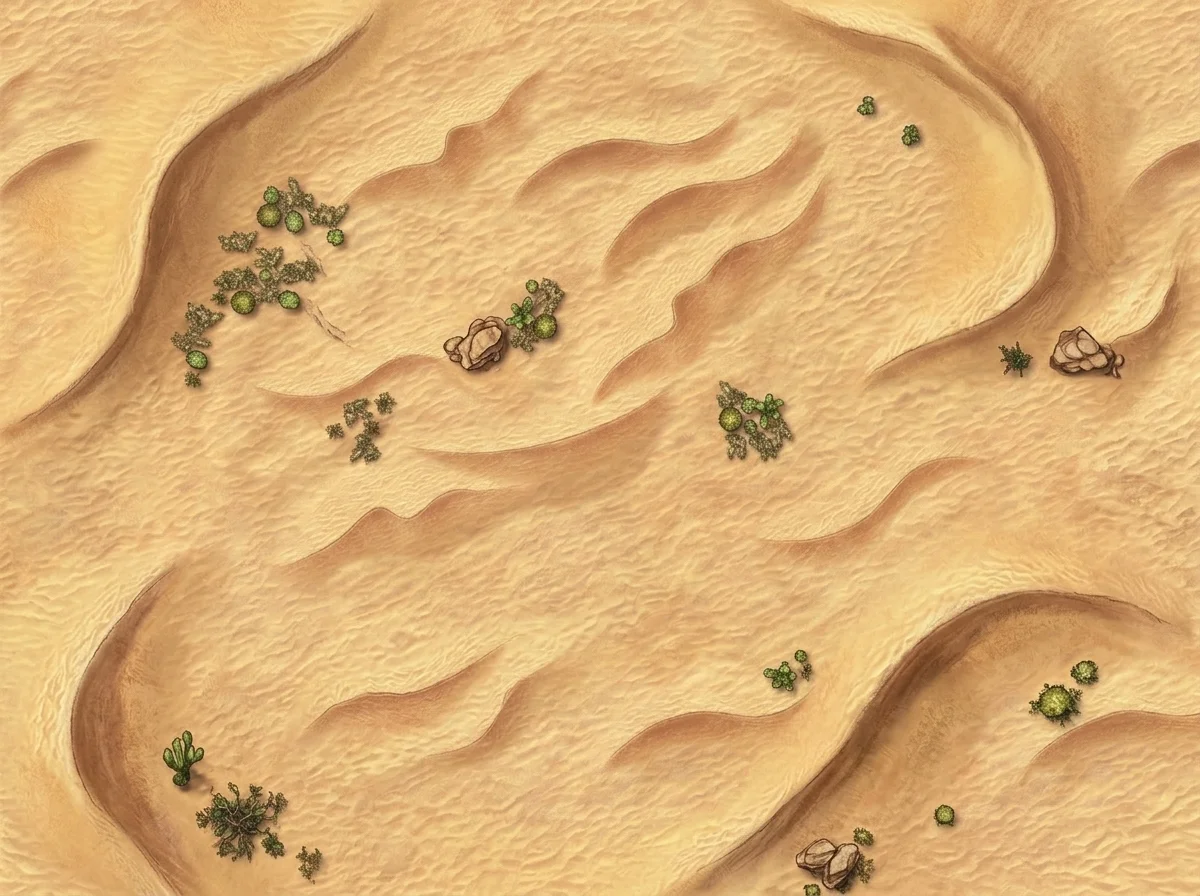 Sand dune ridgelines on a desert biome map create natural elevation for ranged combat — and natural concealment for ambush predators.
Step 3: Prep Ancient Sites the Desert Reveals (8 Minutes)
Deserts are geological time machines. Sand shifts, and things buried for centuries become accessible overnight. This is free encounter design — the desert does the dungeon-building for you.
Half-Buried Temples
A temple 70% underground and 30% exposed by wind erosion is a better dungeon entrance than any cave mouth. The party sees architecture from the surface — carved columns, a fragment of mosaic floor, a staircase descending into darkness. I give each exposed temple 3 visible features and 1 hidden hazard. The features draw players in. The hazard — a ward still active, a structural weakness, a creature nesting above — makes the decision to enter meaningful.
In my desert one-shot for the Friday group, I placed a half-buried temple on the battle map and told the party they could see a glowing sigil 15 feet below the sand line through a crack in the wall. Dan's wizard went in alone. Dan's wizard regretted going in alone.
Exposed Artifacts as Plot Devices
A sandstorm that exposes an ancient road is an adventure hook. A sandstorm that reveals a sealed stone door with writing no one can read is a campaign hook. I prep 2 exposed-artifact encounters per desert arc: one valuable, one dangerous. The party doesn't know which is which until they interact. For more on layering ruins and oasis encounters, check out how terrain types work in desert maps.
Step 4: Design Creature Lairs Around Adaptation (5 Minutes)
Desert monsters aren't just regular monsters in a hot place. The creatures worth putting on your dnd desert map are the ones adapted to the terrain in ways that create tactical problems.
Ambush Predators
Creatures that burrow — purple worms, ankhegs, bulettes — turn the ground itself into a threat. When the terrain is the enemy, movement becomes the core tactical decision. I place burrow-capable creatures near landmarks the party must cross: a bridge over a dry riverbed, the approach to an oasis, the only gap through a canyon wall.
Heat-Adapted Pack Hunters
Creatures that hunt at dusk or dawn force the party to choose when they travel. Moving at noon is safe from predators but punishing from heat. Moving at dawn is cooler but coincides with the hunting window. This isn't a survival mechanic — it's a scheduling puzzle with real consequences.
Territorial Creatures Near Water
The most dangerous desert encounter isn't a monster in open wilderness. It's a monster that has claimed the only water source within a day's travel. The party can't avoid it. They can't go around. They have to negotiate, fight, or find another way to hydrate. For building terrain that supports these confrontations, desert terrain design principles cover the tactical side in detail.
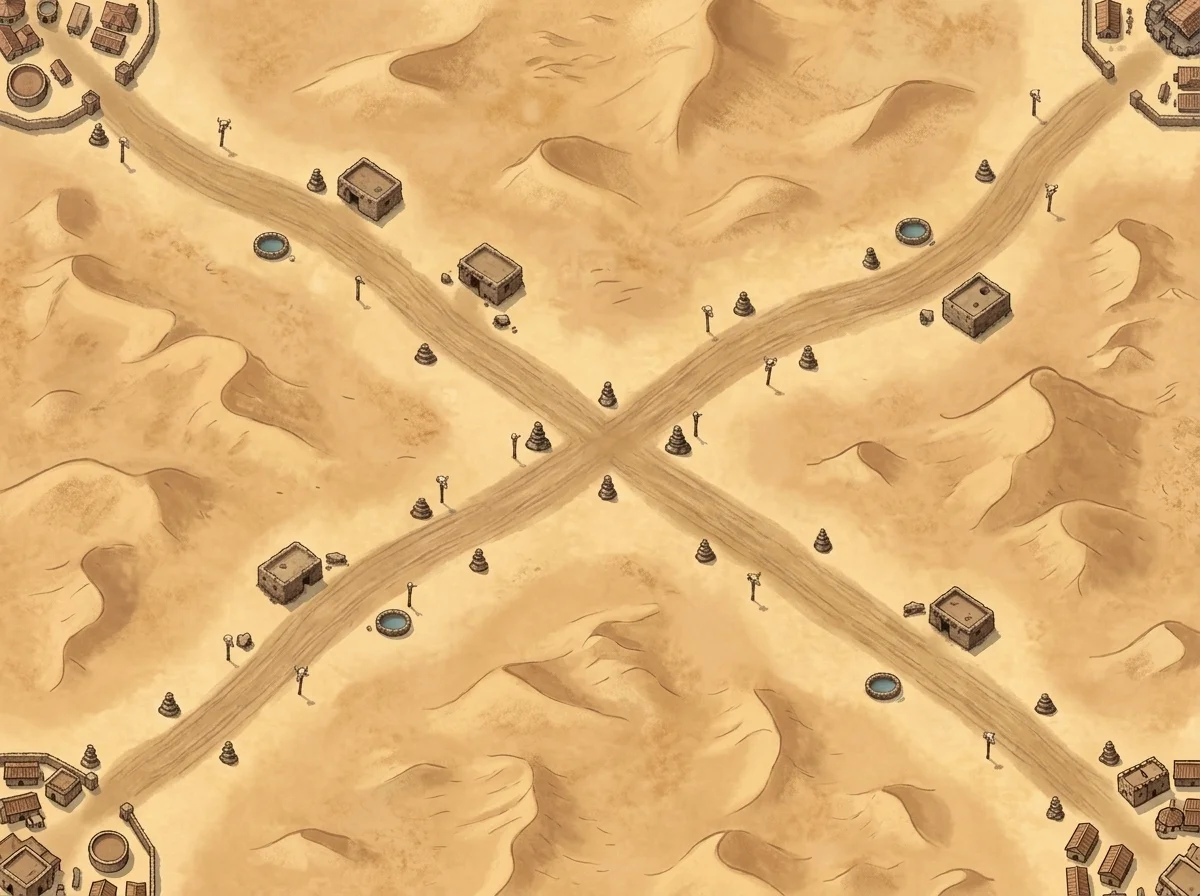 A caravan route on a fantasy desert map — every chokepoint between those rock formations is a potential encounter site.
When This Workflow Doesn't Apply
- Short desert crossings (1-2 sessions). If the party is just passing through, pick one category — probably environmental puzzles — and run that. A 2-session desert crossing needs a sandstorm and one landmark, not a political web.
- High-level parties with teleportation. A group that can Teleport or Wind Walk across the desert bypasses everything terrain-dependent. At that tier, the desert is a backdrop for a specific destination, not a sandbox.
- Campaigns where survival IS the point. If your entire premise is "stranded in the desert, must survive" — like a Dark Sun campaign — then heat and thirst are the encounter. This workflow assumes the desert is a setting, not the challenge itself.
30-Minute Desert Encounter Prep — Quick Reference
Minutes 1-10 — Political layer. Mark water sources on the map. Assign 1 faction per source. Write 1 conflict per faction pair. Three lines per oasis is enough.
Minutes 11-17 — Environmental puzzles. Prep 1 sandstorm event with a party-splitting mechanic. Add 1 mirage carrying useful but unreliable information. Place 1 terrain trap near a landmark.
Minutes 18-25 — Ancient sites. Drop 1 half-buried ruin onto the desert biome map with 3 visible features and 1 hidden hazard. Add 1 exposed artifact with ambiguous value.
Minutes 26-30 — Creature lairs. Pick 1 ambush predator near a travel chokepoint. Place 1 territorial creature at a water source. Note their hunting schedules.
Four categories. 30 minutes. Your desert goes from Constitution-save gauntlet to the kind of sandbox your players actually want to explore.
The Friday group's desert one-shot went 5 hours. They spent 90 minutes on the oasis negotiation, 40 minutes in the buried temple, and exactly 0 minutes tracking water rations. At the end of the session, Marcus said it was the first time a desert felt like a place instead of a weather effect.
The desert doesn't need to be about survival. It needs to be about what people do when every scarce resource becomes political, when the ground hides centuries of history, and when the only water for 40 miles belongs to something that doesn't want to share.
Build that desert biome map. Your players will find the story themselves.
Related Reading
- Desert Terrain Design for D&D Maps — terrain types, elevation, and line-of-sight for desert combat encounters
- Oasis and Ruin Encounters for Desert Campaigns — encounter design around the two anchor points of any desert map
- 3 Battle Map Mistakes I Made for 4 Years — the same flat-terrain problem applies to desert maps
- How to Prep a Dungeon in 20 Minutes — the time-boxed prep philosophy this desert workflow borrows from

Written by
Toby
Indie Developer & Creator of FantasyGen
Toby is an independent developer focused on building AI-powered creative tools. He created FantasyGen to help game masters and worldbuilders generate fantasy maps instantly — no artistic skills required.
Continue the Campaign
Fantasy Desert Map Design: Oases, Ruins, and the Paths Between
Learn how to design a fantasy desert map with oases as hubs, ancient ruins as dungeons, and caravan routes as encounter paths. A DM's campaign case study.
DnD Desert Maps: Why Empty Sand Makes the Best Battle Terrain
Your dnd desert map looks empty. That's the point. Open sightlines, shifting dunes, and heat pressure create tactical combat most terrain types can't match.
How to Map a Cave System Without Getting Lost in Your Own Design
My 5-step workflow for designing cave map systems that stay playable. Start with entrance type, limit branches, add landmarks, loop dead ends — no spaghetti.