

Best Maps for Tabletop RPGs: Styles & Tips for Every Game Master
Explore the best tabletop RPG maps, from parchment world maps to tactical battle grids. Learn which map styles fit your campaign and how AI generators speed up game prep.
Every great tabletop RPG session starts with the right map. Whether you are running a political intrigue through cobblestone streets or an ambush in a volcanic cavern, the best maps for tabletop RPGs are the ones that pull your players deeper into the fiction. A well-chosen map transforms a dry narration into an immersive, tactile experience—and in 2026, Game Masters have more options than ever to get the perfect visual for every encounter.
This guide breaks down the essential map styles, explains when to use each one, and shares pro tips that seasoned GMs swear by. If you have ever stared at a blank canvas wondering where to begin, you are in the right place.
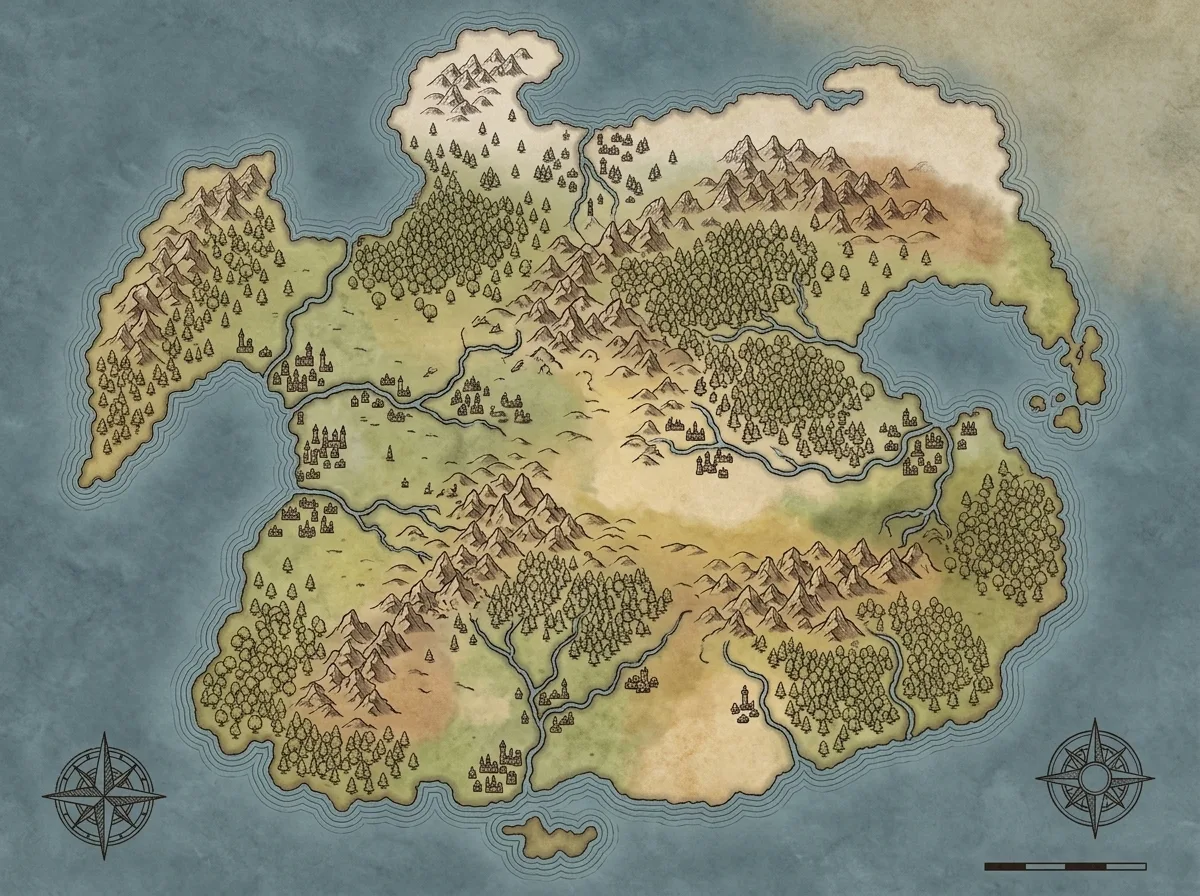 Prompt: "An epic fantasy world map rendered on aged parchment paper with intricate hand-drawn cartography, featuring towering mountain ranges, dense ancient forests, winding rivers cutting through valleys, and tiny medieval castles dotting the landscape, top-down orthographic view, warm sepia and amber tones, detailed ink linework, vintage cartographic aesthetic, ultra-detailed Inkarnate style"
Why Map Choice Matters More Than You Think
A map is not just decoration. In tabletop RPGs, maps serve three critical functions:
- Spatial Communication — They tell players exactly where they can move, hide, and attack. Ambiguity during combat leads to arguments; a clear map prevents that.
- Narrative Anchoring — A beautifully rendered world map makes your homebrew setting feel real and lived-in. Players remember landmarks they can see.
- Pacing Control — Revealing a dungeon room-by-room with Fog of War keeps tension high. Showing a vast overland map signals a shift to exploration mode.
The mistake most new GMs make is using the same map type for every situation. A continent-scale world map is useless during a bar fight, and a 5-foot grid battle map cannot convey the grandeur of an empire. Understanding which tabletop RPG maps to use and when is the single biggest upgrade you can make to your sessions.
The 5 Essential Map Types Every GM Should Know
1. World Maps — The Big Picture
World maps show continents, oceans, mountain ranges, and political borders. They are the first thing your players see when you introduce a new campaign setting, and they set the tone for everything that follows.
When to use: Session zero introductions, long-distance travel planning, political campaigns, and sandbox-style exploration arcs.
Key elements: Coastlines, terrain variety (forests, deserts, tundra), major cities, trade routes, and bodies of water.
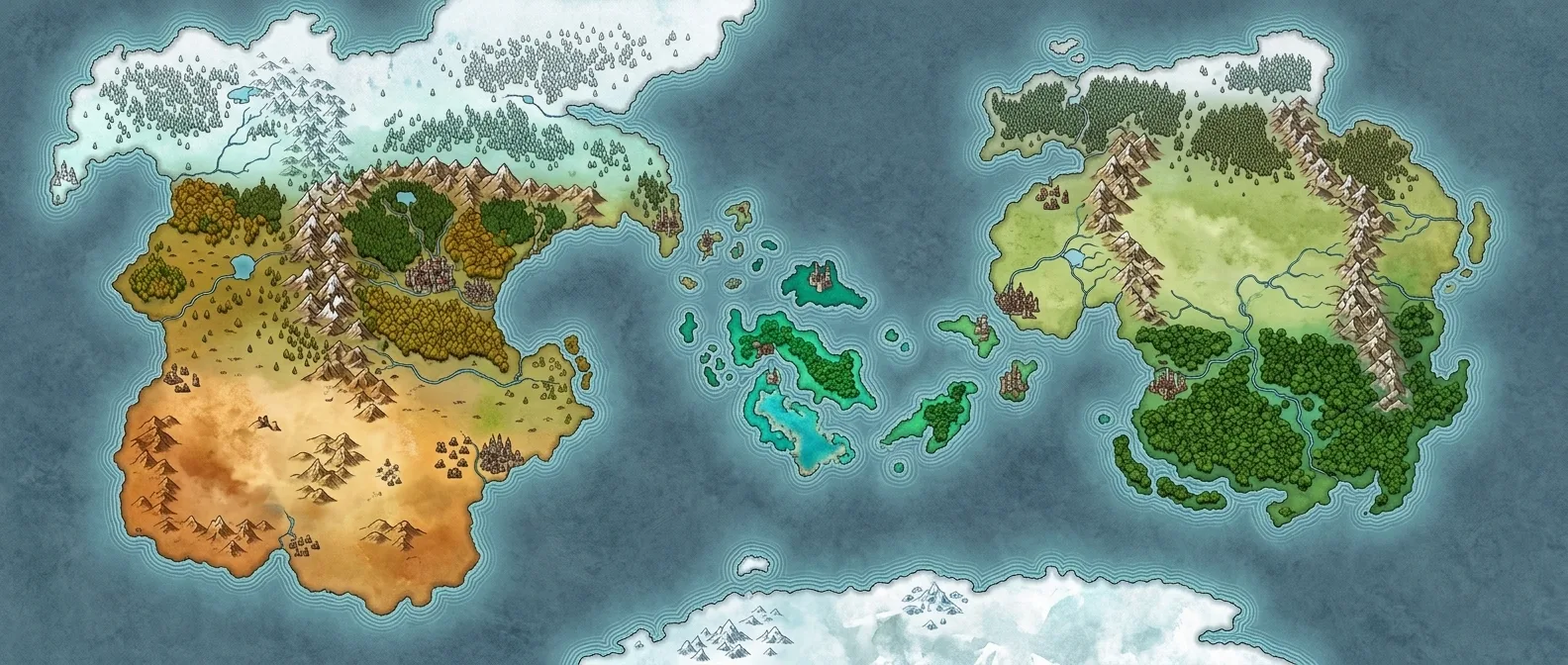 Prompt: "A sprawling fantasy world map featuring three distinct continents of varying size surrounded by vast oceans and scattered archipelagos, the largest continent displaying rich biomes from dense tropical rainforests to arid deserts and frozen tundra, realistic geographic transitions, deep blue oceans, top-down cartographic view, ultra-detailed painterly style"
Pro Tip: Don't try to detail every inch of your world map. Focus on the 2-3 regions your players will actually visit in the next few sessions. You can always flesh out the rest later. Need a starting point? Try our fantasy world map generator guide.
2. Region Maps — The Sandbox
Region maps zoom in on a specific area—a kingdom, a river valley, a chain of islands. They are the workhorse of most campaigns because this is where your players spend most of their time making decisions: which road to take, which town to visit, which ruin to investigate.
When to use: Overland travel, hex-crawl exploration, quest hubs, and mid-campaign arcs.
Key elements: Roads and trails, settlements of varying size, natural landmarks (rivers, lakes, forests), ruins, and points of interest.
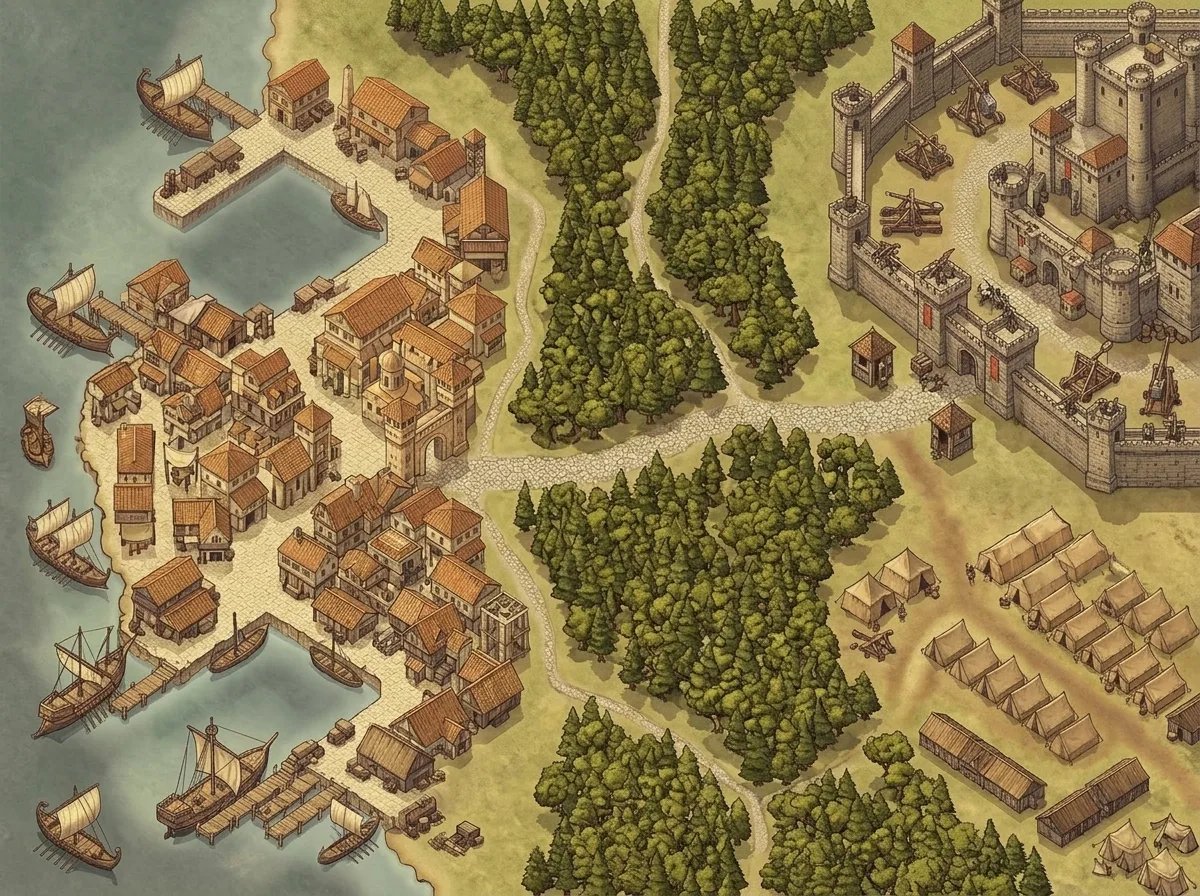 Prompt: "A top-down regional fantasy map featuring a bustling coastal port trading city surrounded by smaller settlements, a main road leading into a dense central forest with branching minor paths, a fortified medieval military city with checkpoints and an organized encampment, rolling green countryside, warm natural lighting, detailed cartographic style, ultra-detailed Inkarnate style"
A strong region map gives players agency. When they can see three roads leading out of town—one through a forest, one along the coast, and one past a crumbling fortress—they naturally start asking questions and making plans. That is the magic of visual storytelling. For campaign-scale region planning, see our campaign map generator guide.
3. Battle Maps — The Tactical Grid
Battle maps are the most commonly used tabletop RPG maps at the table. They show a specific location at a 5-foot-per-square scale, designed for miniature or token placement during combat encounters. Every wall, tree, and piece of furniture matters here because it affects movement, cover, and line of sight.
When to use: Any combat encounter, skill challenges with spatial elements, chase sequences.
Key elements: Walkable terrain, cover (full and partial), difficult terrain, elevation changes, environmental hazards, and clear boundaries.
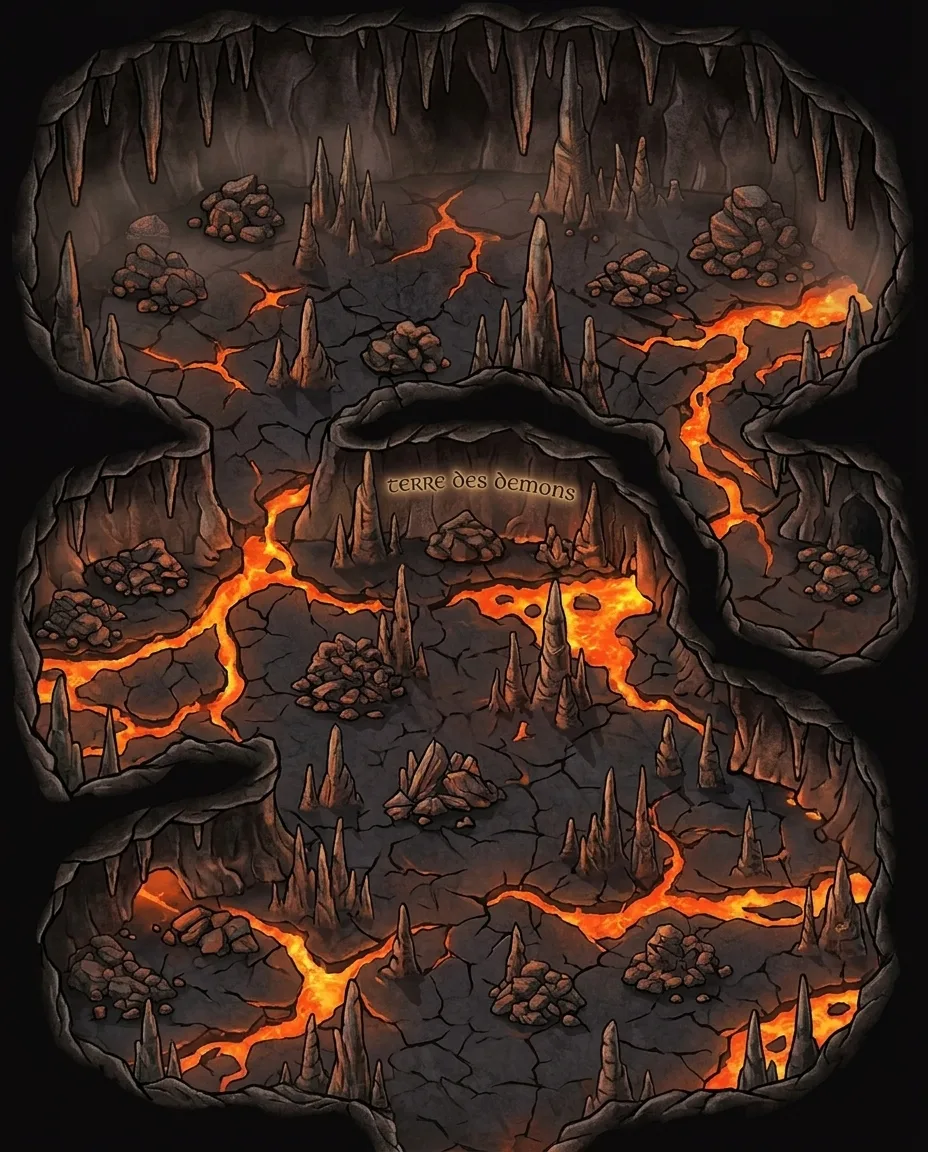 Prompt: "A top-down tactical battle map of a perilous volcanic cave chamber with cracked dark obsidian ground, glowing rivers of molten lava snaking through deep fissures, jagged stalagmites and stalactites, scattered volcanic rock formations providing tactical cover, narrow winding passages connecting strategic alcoves, thick sulfurous haze, dramatic orange and crimson underlight, orthographic view, ultra-detailed Inkarnate style"
The difference between a mediocre battle map and a great one is tactical depth. Flat, empty rooms lead to boring "I attack the nearest enemy" gameplay. Add chokepoints, destructible pillars, lava rivers, or collapsing floors, and suddenly every player is thinking creatively. Dive deeper into battle map design with our battle map generator guide.
4. Dungeon Maps — The Classic Crawl
Dungeon maps are a subset of battle maps, but they deserve their own category because of how central they are to D&D and similar systems. A dungeon map shows interconnected rooms, corridors, traps, secret doors, and treasure locations. They are typically revealed gradually using Fog of War.
When to use: Dungeon crawls, heists, underground exploration, lair assaults, and horror scenarios.
Key elements: Room layout and connectivity, door types (locked, trapped, secret), traps, treasure locations, and environmental storytelling elements (bloodstains, collapsed tunnels, altars).
The golden rule of dungeon design: every room should present a choice or a consequence. Dead-end hallways waste time. Branching paths that loop back on themselves create tension and reward clever exploration. Check out our dungeon map generator guide for rapid dungeon creation.
5. City & Settlement Maps — The Social Hub
City maps are where roleplay-heavy sessions shine. They show districts, notable buildings, marketplaces, guard barracks, and the general layout of an urban environment. You rarely need grid-level precision here—broad strokes are enough to help players navigate the social landscape.
When to use: Urban adventures, political intrigue, shopping sessions, investigations, and faction-based campaigns.
Key elements: Districts with distinct character, key landmarks (temples, palaces, guildhalls), gates and walls, waterways, and slum vs. noble quarter contrasts.
A common mistake is making cities feel like a list of shops. Instead, think of each district as a mini-region with its own personality and conflicts. Our fantasy city map generator guide walks you through building cities that breathe.
Beyond Fantasy: Genre-Bending Map Styles
Tabletop RPGs are not limited to medieval fantasy. Systems like Starfinder, Cyberpunk RED, and Lancer demand entirely different visual languages. The good news is that modern AI map generators handle these styles with ease.
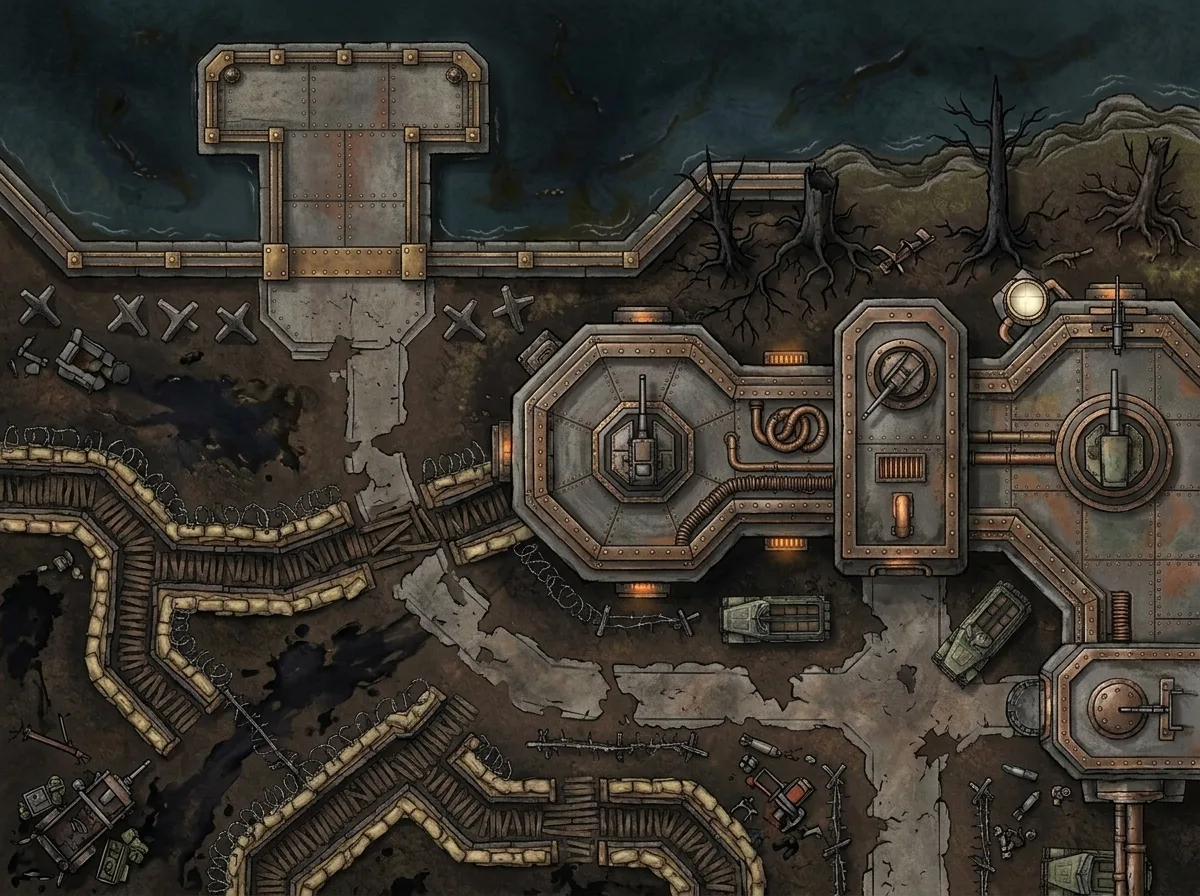 Prompt: "A top-down tactical battle map of a dieselpunk coastal warzone featuring fortified concrete bunkers, sandbagged battlements, artillery emplacements overlooking a rugged shoreline, crashed armored vehicles, bombed-out craters, dark storm clouds over turbulent coastal waters, gritty industrial military aesthetic, muted olive and gunmetal tones, orthographic view, ultra-detailed tactical map style"
Whether you need a neon-lit cyberpunk alleyway, a war-torn dieselpunk beachhead, or a sterile spaceship corridor, all you have to do is describe the scene. The AI map generator translates your words into a fully rendered environment in seconds—no asset packs or genre-specific software required.
7 Pro Tips for Choosing and Using Tabletop RPG Maps
Here are practical tips that experienced Game Masters use to get the most out of their maps:
| # | Tip | Why It Works |
|---|---|---|
| 1 | Match scale to stakes | Use world maps for epic moments, battle maps for combat. Mismatched scale kills immersion. |
| 2 | Generate without grids | Let your VTT handle grid overlay. Gridless maps look cleaner and adapt to hex or square systems. |
| 3 | Light tells a story | A moonlit ruin and a torchlit ruin evoke completely different moods. Specify lighting in your prompts. |
| 4 | Reuse and reskin | A "forest clearing" battle map works for bandits today and wolves next week. Rotate your library. |
| 5 | Less is more for world maps | Players remember 5 named regions better than 50. Start sparse, expand over time. |
| 6 | Add verticality to battles | Cliffs, balconies, and multi-floor buildings force 3D thinking and reward creative tactics. |
| 7 | Keep a map library | Build a folder of go-to maps for improvised encounters. You will thank yourself mid-session. |
How AI Is Changing Tabletop RPG Cartography
Traditional map-making tools like Inkarnate and Wonderdraft are powerful, but they require hours of manual placement. In contrast, AI-powered generators let you describe a scene in plain English and receive a finished map in seconds.
This shift has three major implications for GMs:
- Prep time drops dramatically. What used to take an evening now takes 30 seconds. You can generate five variant maps and pick the best one.
- Improvisation becomes visual. Players take an unexpected turn? Generate a new map on the spot without pausing the session.
- Quality is no longer gated by skill. You don't need artistic ability to produce professional-grade cartography. Your imagination is the only limit.
If you are curious about how AI handles the technical details, our AI map generator deep dive explains the technology behind the scenes. And if you are torn between manual tools and AI, check out fantasy map maker vs generator for an honest comparison.
FAQ: Tabletop RPG Maps
What is the best map size for a D&D battle map? For virtual tabletops, a resolution of around 3500 × 2500 pixels at 140 pixels per grid square works well. For printed maps, aim for 1 inch per 5-foot square at 300 DPI.
Can I use AI-generated maps commercially (e.g., for a published module)? With FantasyGen, all generated images are yours to use for personal and commercial projects. Always check the licensing terms of any tool you use.
Do I need different maps for D&D vs. Pathfinder vs. other systems? The visual style is interchangeable. The main difference is grid type—D&D traditionally uses squares, while some systems prefer hexes. Generate gridless maps and apply the overlay in your VTT.
How many maps should I prepare per session? For a typical 3-4 hour session, prepare 1-2 battle maps and have your region or world map accessible. Keep 2-3 generic backup maps for unexpected encounters. Learn the full prep workflow in our how to make D&D maps guide.
Conclusion
The best tabletop RPG maps are the ones that serve your story. A parchment-style world map sets an epic tone for session zero. A gridded tactical map with lava hazards turns a routine fight into a memorable set piece. A detailed city map gives your players the freedom to explore on their own terms.
In 2026, you no longer have to choose between quality and convenience. AI map generators like FantasyGen make it possible to produce any style, any genre, and any scale in seconds—so you can spend less time prepping and more time playing.
Pick a map style. Describe your scene. Let the adventure begin.
Explore more resources to level up your Game Master toolkit:
- D&D Map Generator
- RPG Map Generator for Game Masters
- Region Map Generator
- Inspiration Gallery
- DnD Kingdom Maps: 5 Layouts for Different Government Types — Kingdom maps shaped by politics, not just terrain.

Written by
Toby
Indie Developer & Creator of FantasyGen
Toby is an independent developer focused on building AI-powered creative tools. He created FantasyGen to help game masters and worldbuilders generate fantasy maps instantly — no artistic skills required.
Continue the Campaign
D&D Map Scale: When I Stopped Using the 5-Foot Grid
Why the standard 5-foot grid doesn't fit every D&D encounter — and the 3 alternative scales I use for wilderness, chase scenes, and city exploration.
The 7 Questions I Answer Before Drawing a World Map
The 7-question checklist I use before generating any fantasy world map — from continent count to blank space allocation. Takes 15 minutes, saves 15 hours.
5 Battle Map Themes I Reuse Every Campaign
The 5 battle map environments I prep once and reuse across every D&D campaign — forest road, tavern brawl, bridge crossing, cave ambush, and rooftop chase.