

How to Run a Tavern Encounter That Isn't Just 'Roll Initiative'
A 5-step workflow for running a tavern encounter that mixes social tension, environmental triggers, and combat without defaulting to flat initiative rolls.
Session 29 of the Shattered Coast. The party walks into a dockside pub in Driftholm — salt-crusted windows, a floor that hasn't been dry since construction. I had 4 NPCs prepped, a smuggling lead, and a tavern map loaded into Foundry VTT. Within 90 seconds, Marcus's fighter insulted a dockworker. Jess's rogue reached for her daggers. I did what I'd done 40 times before.
"Roll initiative."
Wrong call. The fight lasted 3 rounds, nobody remembered the smuggling lead, and the NPCs I'd spent 20 minutes prepping became generic combatants. Mechanically fine. Narratively dead.
I've rebuilt how I run dnd tavern maps encounters from the ground up. Here's the 5-step workflow — tested across 14 tavern encounters in the last year — that turns a flat bar fight into a scene players reference for months.
Step 1: Set the Stage with Sensory Pressure (Before Anyone Sits Down)
Most DMs describe the room but not the pressure in the room.
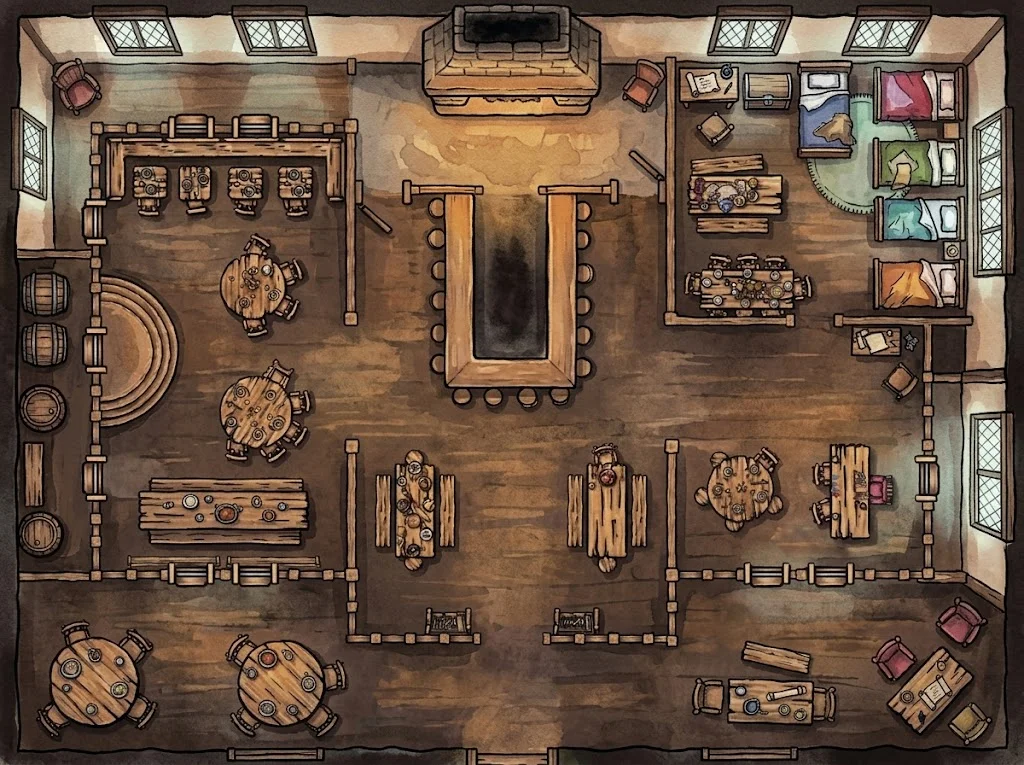
A good dnd tavern map gives you the physical layout. Necessary, but insufficient. The encounter starts working when you layer sensory details that signal something is about to happen. I call these "pressure signals" — details that make players lean forward before dice hit the table.
My formula for the first 60 seconds after the party enters:
- One sound that's wrong (sudden silence when they walk in, a chair scraping, someone stopping mid-laugh)
- One smell that tells a story (cheap perfume over blood, gunpowder residue on a sailor's coat, food that's been sitting untouched)
- One visual that's a ticking clock (a half-drawn blade under a table, a bartender slowly moving bottles below the counter, an exit being blocked)
In the rebuilt Driftholm session, the pressure signal was simple: the spice merchant from Saltmere Market was sitting in the corner, and when the party entered, he stood up and walked directly to the back door. No combat trigger. Just a detail that said this person doesn't want to be seen with you. Jess's rogue followed him. The encounter unfolded from that movement, not from a punch.
The tavern map generator gives you the physical space. Your job is to fill that space with tension before anyone rolls anything.
Step 2: Establish NPC Motivations (The 30-Second Rule)
Most tavern encounters fail because the NPCs don't want anything. They're set dressing until combat starts, then they become stat blocks.
I adapted a technique from Sly Flourish's encounter building: every NPC in the tavern gets a 30-second motivation — one sentence I can remember without notes.
For the rebuilt Driftholm encounter, my NPC cards looked like this:
- Koral (dockworker, scarred hands): Wants to finish his drink and leave before the smugglers arrive. Will fight if cornered.
- Daven (off-duty guard): Drinking to forget he took a bribe last week. Terrified of being recognized.
- The Bartender: Owes money to whoever walks in with a Shard Isles accent. Will lock the door if violence starts — to keep witnesses inside, not to help.
- Rila (bard): Here to gather information for a competing smuggling operation. Will escalate any argument to cover her own exit.
Four NPCs. Four motivations. The encounter isn't "bar fight or not." It's a room full of people whose secrets are about to collide.
This is where your dnd tavern map earns its value — point to the layout and say "Koral is at the bar, Daven is by the stairs, Rila is near the hearth." Geography creates opportunity.
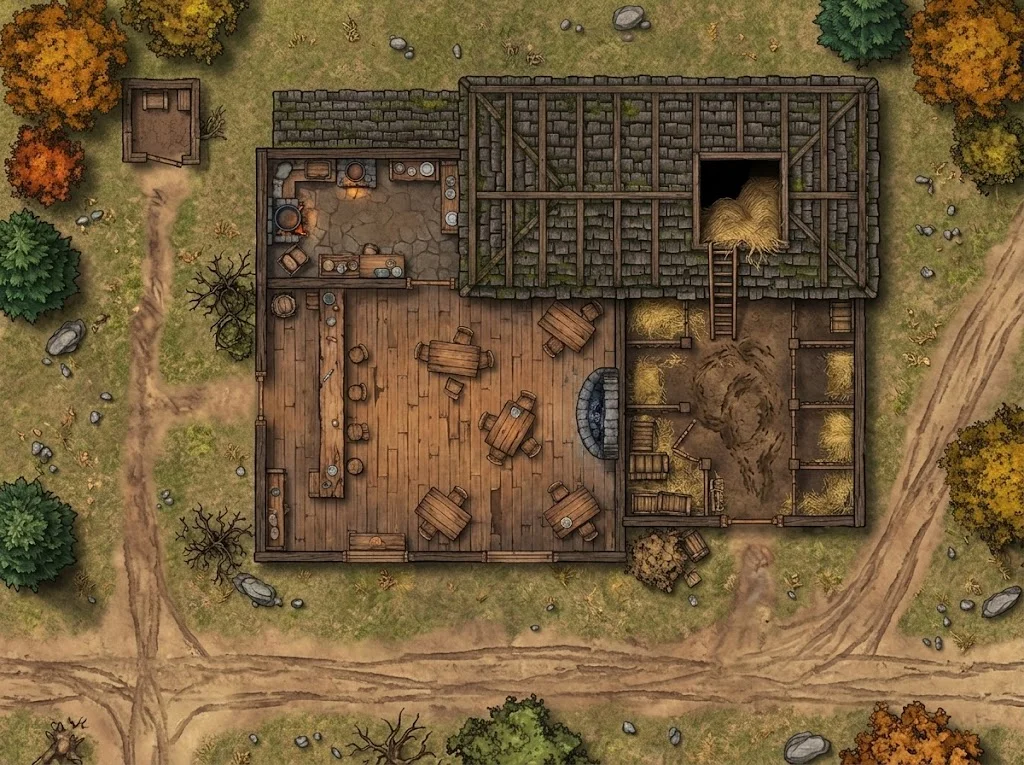 The layout dictates the drama — who's near the exit, who's trapped by the bar counter, who has a clear line to the stairs.
Step 3: Environmental Triggers That Escalate (Not Initiative)
Here's my contrarian position: the DM should almost never call for initiative in a tavern.
Initiative flattens social encounters into turn order. The moment you say "roll initiative," every NPC becomes an enemy or ally in mechanical terms. The gray zone — where the guard might help you or arrest everyone — disappears.
Instead, I use what r/DMAcademy users call "escalation triggers." Environmental events that raise stakes without forcing combat:
- The candle trigger — something falls and breaks (a lantern, a bottle, a chair). Noise attracts attention. Now everyone's watching.
- The door trigger — someone new enters or someone tries to leave. Changes the power dynamic.
- The reveal trigger — a hidden weapon is spotted, a disguise slips, someone says the wrong name.
Each trigger gives players a choice: de-escalate, press harder, or bolt. Combat becomes one possible outcome instead of the default.
In my pirate one-shot for the Friday group, I used 3 triggers across 8 minutes of real-time play before the first punch landed. Trigger 1: a drunk sailor knocked a lantern off the bar (fire spreading toward lamp oil). Trigger 2: the bartender reached for a crossbow under the counter. Trigger 3: a player spotted the "dead" captain's signet ring on a stranger's finger. By the time combat started, it felt earned — not random.
I track trigger timing on a d6 countdown. Roll a d6 at the top. Every 2 minutes of real time (or every player action that raises tension), tick down by 1. When it hits 0, the next trigger fires. Players don't see the countdown. They feel the pressure building.
Step 4: Escape Routes and Consequences
A tavern battle map needs at least 3 exits. Most published maps have one door. That's a cage, not a scene.
When I generate a layout, I check for: front door, back door or window, and one unconventional exit (rooftop hatch, cellar trapdoor, a wall thin enough to bash through). If the map lacks these, I add them in Foundry. This comes from running city-scale encounters — escape routes determine whether a scene feels like a skirmish or a trap.
Consequences matter more than damage. After the Driftholm docks encounter, I prepped a 3-column fallout table:
| If the party... | Immediate result | Session 31 consequence |
|---|---|---|
| Killed Koral | Smugglers lose a contact; shipment delayed | A bounty appears on the party — dockworkers' guild |
| Let Daven escape | He reports to the guard captain | The captain knows the party is investigating |
| Captured Rila | She trades information for freedom | The competing operation sends backup |
None of these require a fight to trigger. The encounter's real output isn't XP — it's narrative pressure that carries forward.
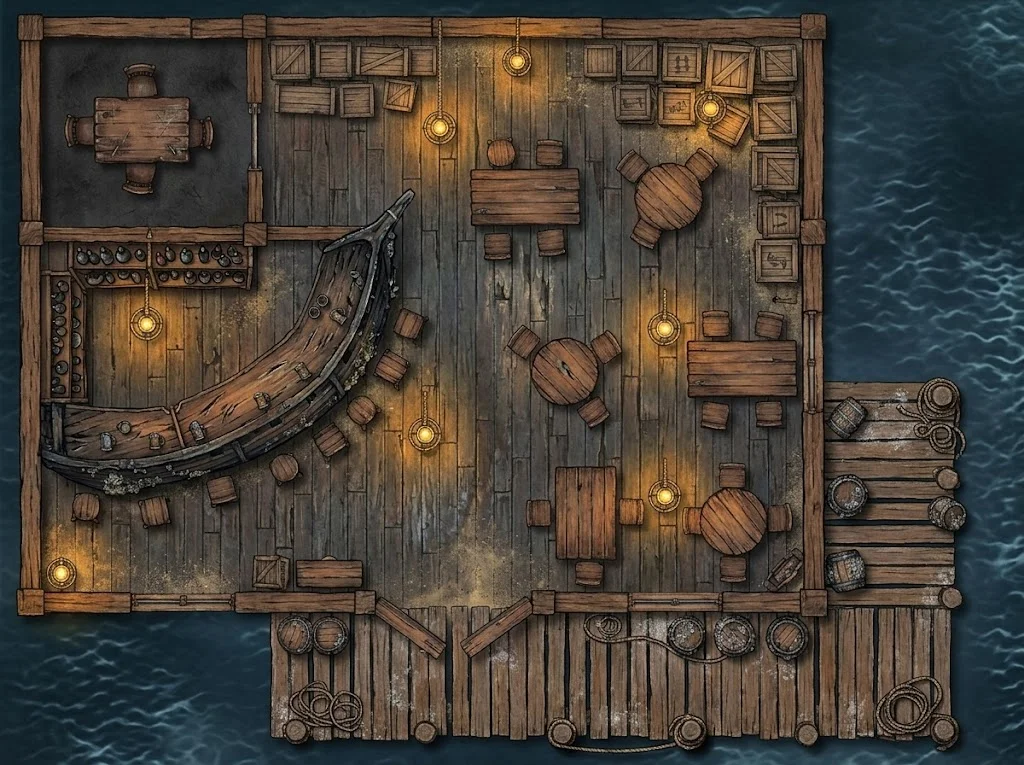 Dockside taverns need water access — it's not atmosphere, it's an escape route. Any NPC within 10 feet of that dock can disappear in one round.
Step 5: Post-Encounter Fallout (The Part Most DMs Skip)
The encounter doesn't end when the last NPC drops or flees. It ends when the consequences arrive.
I learned this across 12 sessions in Driftholm: tavern encounters that end cleanly get forgotten. Encounters with fallout become campaign-defining moments. Session 34 — when my players brought a conspiracy whiteboard to my house — grew from a tavern scene where they let the wrong person escape.
My post-encounter checklist:
- Who saw what? The bartender, surviving patrons, anyone who heard glass break. Witnesses create future leverage — for NPCs and players.
- What got damaged? Property destruction has social cost. The party now owes someone a debt or has an enemy.
- Who didn't show up? The NPC who was supposed to arrive but saw chaos through the window and walked away. That's next session's hook.
This is where a good tavern battle map with reusable layouts saves you — when you know you'll return to the same tavern 3 sessions later, the map becomes a character with battle scars.
What I Got Wrong Before This Workflow
I treated tavern encounters as combat or social — never both. The encounter has to breathe between modes. A conversation escalates into a shove, de-escalates into threats, explodes into 2 rounds of combat, ends in a chase. One encounter, not four.
I forgot that tavern maps need interactable objects, not just walls. A dnd tavern map designed for bar fights should have throwable objects, breakable furniture, and at least one fire source. I annotate my maps with "interactive" markers so players see which objects are usable.
I let players default to violence when they were bored, not when the scene demanded it. If players go to "I attack" within 30 seconds of entering a tavern, that's my failure as a DM — the scene wasn't interesting enough to interact with non-violently.
When This Workflow Breaks
- One-player-character parties or very small groups (2 PCs). The social web needs at least 3 players to generate enough competing motivations. With 2, conversations collapse into a single thread.
- Purely comedic tavern scenes. If the table wants a goofy bar fight for stress relief, don't force dramatic escalation.
- High-level parties (tier 3+). When a single fireball can level the building, environmental triggers lose their teeth. The "encounter" becomes political — who's watching, not who's fighting.
The 60-Second Prep Card
TAVERN ENCOUNTER PREP
━━━━━━━━━━━━━━━━━━━━━
□ Map loaded (3+ exits marked)
□ 3-4 NPCs with 1-sentence motivations
□ 3 sensory pressure signals written
□ Escalation triggers (d6 countdown)
□ Consequence table (3 outcomes × 2 columns)
□ Post-encounter: witnesses, damage, absent NPC
━━━━━━━━━━━━━━━━━━━━━
Total prep time: 15 minutes
Run your next tavern encounter with this workflow. Not because combat is bad — tavern combat is some of the best tactical play D&D offers. But "roll initiative" should be the climax of the scene, not the opening line.
The tavern is a pressure cooker. Your job is controlling the heat.
Related Reading
- Tavern Map Generator — Generate Custom DnD Tavern Maps — the tool I use to generate tavern layouts with multiple floors and exit points
- City Map Generator — when your tavern encounter spills into the surrounding streets
- Tavern Battle Map Reusable Layouts — how to build a tavern map you can reuse across 5+ sessions
- DnD Tavern Map Bar Fight Design — tactical furniture placement for maximum combat variety

Written by
Toby
Indie Developer & Creator of FantasyGen
Toby is an independent developer focused on building AI-powered creative tools. He created FantasyGen to help game masters and worldbuilders generate fantasy maps instantly — no artistic skills required.
Continue the Campaign
3 Tavern Battle Maps I Reuse Every Campaign (and How I Mod Them)
I reuse 3 tavern battle map layouts in every D&D campaign. Here's each one with tactical breakdowns, mod ideas, and real combat examples from 340+ sessions.
DnD Tavern Maps: Why Every Bar Fight Needs More Than Tables and Chairs
Your dnd tavern map probably has tables, chairs, and nothing else. Here are 5 overlooked design elements that turn a flat pub into a tactical combat playground.
How to Map a Cave System Without Getting Lost in Your Own Design
My 5-step workflow for designing cave map systems that stay playable. Start with entrance type, limit branches, add landmarks, loop dead ends — no spaghetti.