
3 Tavern Battle Maps I Reuse Every Campaign (and How I Mod Them)
I reuse 3 tavern battle map layouts in every D&D campaign. Here's each one with tactical breakdowns, mod ideas, and real combat examples from 340+ sessions.
Last Friday, 4 rounds into a knife fight at a dockside dive in Driftholm, Jess's rogue kicked a chair into a sailor's knees while Marcus's fighter shoved a smuggler clean through the waterside window. The splash was louder than the initiative roll.
That tavern battle map was 15 × 30 feet. Tight, ugly, and perfect. The fight ran 8 rounds and nobody moved more than 15 feet — every square already had something to interact with.
Here's what most DMs get wrong about dnd tavern maps: they build one tavern and drop it into every scenario. Bar fight? Same map. Back-room deal? Same map. Midnight assassination? Same map. I did this for nearly 2 years before I noticed every tavern encounter played out identically — flip a table, punch someone, walk out the front door.
Three layouts fixed it. Each one handles a fundamentally different encounter shape, and I've run all three across 340+ sessions and 4 campaigns. Here's what they are, why they work, and exactly how I mod them.
Layout 1: The Classic Common Room
Open floor plan, long bar counter along one wall, fireplace opposite, 8–10 tables scattered across a 30 × 30-foot space. This is the tavern battle map you picture first — and the most versatile of the three.
Tactical DNA
The open floor creates a flanking playground. No corridors, no choke points — melee characters circle enemies freely, ranged characters hold sightlines from every corner, and the scattered tables become the primary tactical features. I run tables as half cover (PHB p. 196), flippable with a bonus action, which means every round begins with a positioning decision: stay exposed for a clean shot, or burn your bonus action on cover.
The bar counter runs 15 feet along the wall — long enough to duck behind for three-quarters cover, narrow enough to vault over.
The fireplace is your environmental hazard. Shove a creature into it: 1d6 fire damage, DC 12 Dex save or catch fire. Players figure this out by round 2. Enemies figure it out by round 1.
Matt Colville calls the tavern brawl "the tutorial level of tactical combat." He's right. The common room teaches players that the environment is a weapon before they ever set foot in a dungeon.
How I Mod It
- Standard bar fight: Improvised weapons everywhere — stools (1d4), bottles (1d4), a mounted boar head if you're generous (2d4). I covered running these encounters without derailing the session in my tavern bar fight design post.
- Political meeting gone wrong: Clear tables to the walls, one long central table with a map spread across it. The fight starts when someone flips that table. Fewer cover options, higher stakes.
- Assassination attempt: Dim the lighting. The assassin hides among 8 NPC patrons — simultaneously obstacles and collateral. A d4 per AoE spell counts bystander hits. Nothing kills tension faster than a fireball in a crowded room.
From My Table
Session 34 of the Shattered Coast. The party met a smuggling contact at a tavern in Driftholm's Saltmere Market district — supposed to be a social encounter. Then Marcus spotted the contact's bodyguard reaching for a blade under the table. I pulled the common room layout, dropped in 6 NPC bystanders, and ran the most chaotic 5-round bar fight of the campaign. Two tables flipped, one chair launched through a window, and the barkeep locked himself in the cellar.
Layout 2: The Multi-Level Inn
Ground-floor drinking hall, wooden staircase to an upper balcony with private rooms, and a cellar accessible through a trapdoor behind the bar. This is the tavern battle map I reach for when combat needs a vertical dimension.
Tactical DNA
Three floors connected by choke points. The staircase is 5 feet wide — one creature blocks it entirely. The balcony railing counts as half cover with clear sightlines to the ground floor below. The cellar is a rat trap: one way in, barrel storage for improvised cover, total darkness unless someone brings light.
The vertical split forces a strategic decision before anyone swings a weapon. Hold the ground floor? Push upstairs for the high ground? Retreat to the cellar and force enemies into your kill zone? Each choice creates a different fight from the same dnd tavern map — multiple encounter shapes, zero extra generation time.
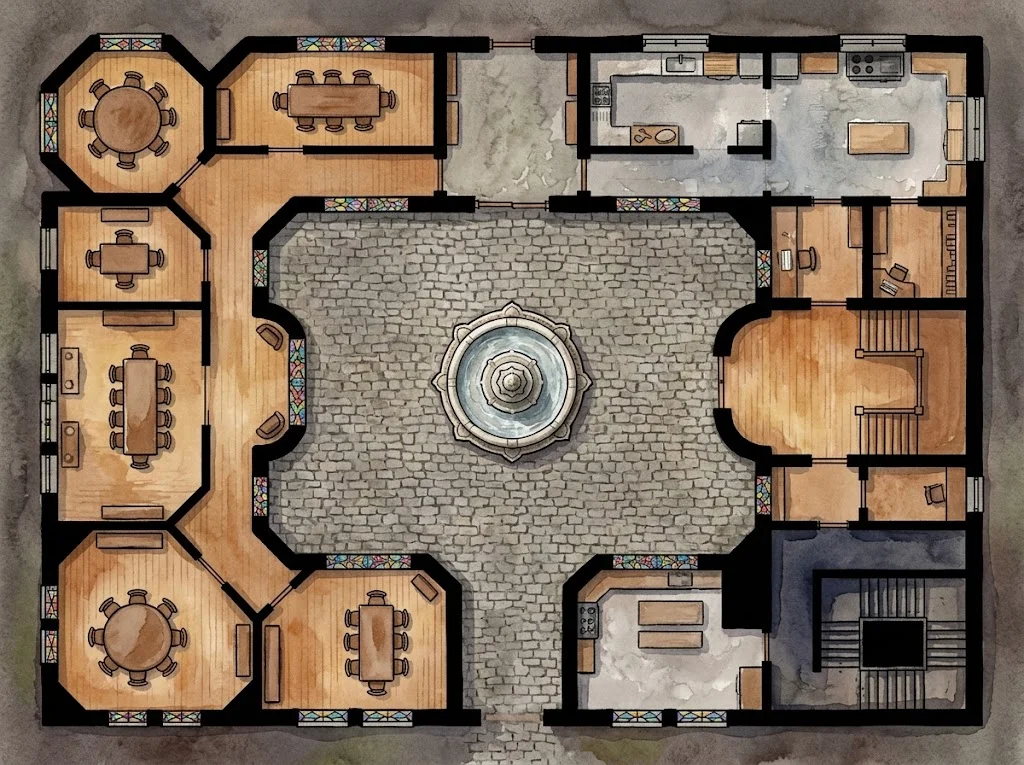 The upscale inn variant — the courtyard adds a fourth tactical zone. I use this version when the party needs an outdoor escape route.
How I Mod It
- Heist extraction: Target is in a second-floor private room. The cellar connects to the city sewers (add a tunnel exit to your map). Stealth upstairs, chase through the basement.
- Barricade defense: The party holds the tavern against an angry mob outside. Board the windows (3 rounds to breach), block the staircase (Sentinel feat heaven), use the balcony for ranged overwatch. I ran this mod once during the Shattered Coast campaign and it produced one of the best encounters I've ever designed.
- Vertical chase: Add a roof hatch from the balcony hallway. Now the inn has 4 exit points — front door, cellar tunnel, roof, and second-floor windows. Perfect for a chase that moves through all three dimensions of the building.
From My Table
The Driftholm smuggling arc (sessions 26–38) used this exact layout 3 times. First visit: the party met a fence in a private upstairs room — pure social encounter, no dice rolled. Second visit: Jess's rogue broke into that same room while the owner slept — pure stealth, 4 tension-filled rounds. Third visit: the whole tavern erupted into a 3-floor running brawl when the smuggling ring connected the dots. Same map. Three sessions. Three completely different encounters.
Layout 3: The Dockside Dive
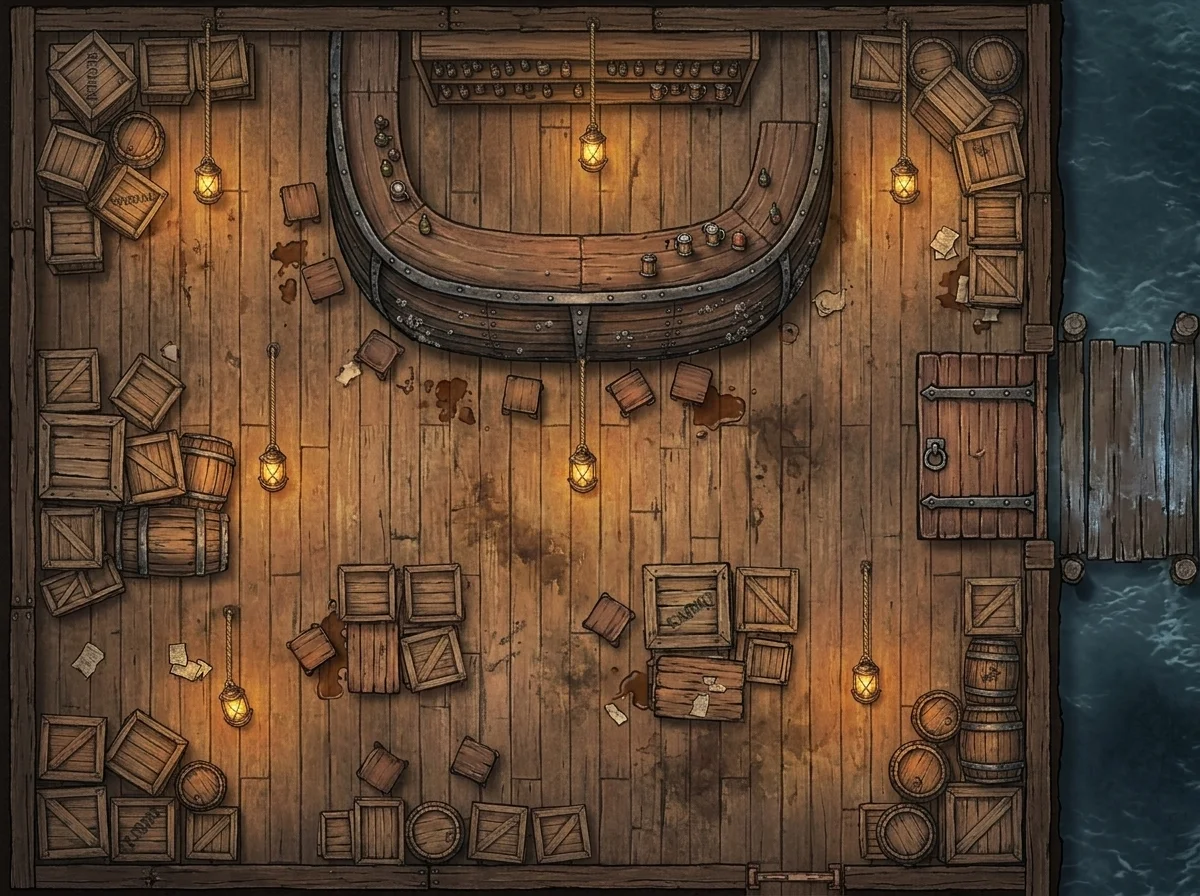
Narrow. Dark. One wall faces the waterfront through a row of grimy windows. The bar is 15 feet long and eats a third of the floor space. A back door opens onto a dock — and a 10-foot drop to cold harbor water.
I built this dnd tavern map for a pirate one-shot I ran for my Friday group set at Driftholm's docks, and it's become my favorite of the three.
Tactical DNA
The narrow floor plan (15 × 30 feet) rewrites the combat math. No room to flank. Melee combat becomes a shoving match — the Shove action matters more on this map than in any other tavern layout I run. The bar counter splits the room in half: go around it (costs movement) or vault over (DC 10 Athletics, 10 extra feet). Every 5 feet of movement is a real decision here.
The waterside windows are the star feature. Break one as a bonus action, jump 10 feet to the dock or 15 feet to the harbor. I've had 4 different NPCs escape through those windows across campaigns. A discussion on r/DMAcademy about tavern design convinced me every tavern needs at least 2 exits. This dive has 4: front door, back dock, windows, and a trapdoor into the bilge.
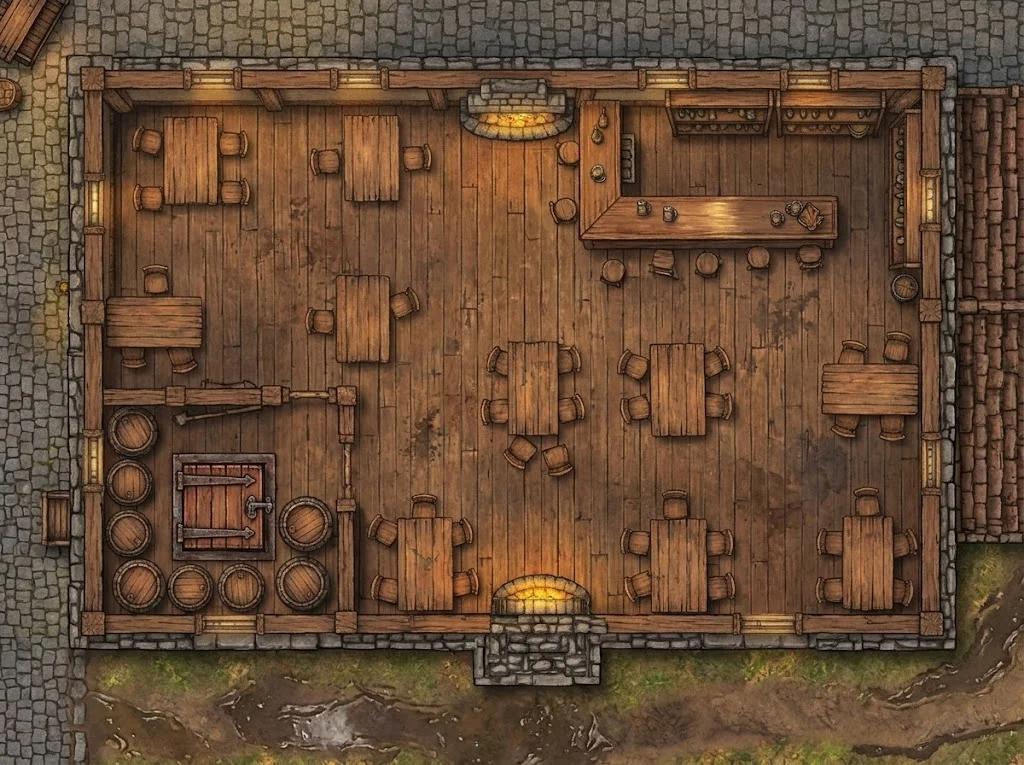 The hidden cellar variant — add a trapdoor behind the bar for a smuggler's stash. Investigation sessions that turn violent love this layout.
How I Mod It
- Pirate negotiation: Long table in the center. The captain sits with his back to the water — power position plus escape route. Six armed crew line the walls, outnumbering the party. Tension before anyone touches a weapon.
- Illegal den: Replace the tables with cots and curtained partitions. Limited sightlines, no room for a greatsword, knife fights in near-darkness. Perfect for an undercover infiltration that goes sideways.
- Fog ambush: Dockside means fog. Drop visibility to 15 feet. The narrow room becomes suffocating, and the windows become a defensive liability — anyone can climb in from the dock outside.
From My Table
The Friday pirate one-shot at a dive called The Barnacle — Driftholm's waterfront at its grimiest. The party was meeting a fence to offload stolen cargo. The fence showed up with 4 armed sailors. When the negotiation collapsed, Marcus shoved the first sailor through the waterside window. The splash was the initiative roll. Two enemies bolted through the back dock. One dove into the harbor. Jess vaulted the bar, grabbed the fence's ledger, and was out the front door before round 3.
Eight rounds of chaos in 450 square feet. Three players later said it was the best combat of the one-shot — and none of them moved more than 10 feet per turn.
How the Three Combine
Common room for open brawls. Multi-level inn for vertical complexity. Dockside dive for tight, desperate fights. Between the three, they cover every tavern encounter I've run across 4 campaigns.
The rare outliers — a massive 40 × 40-foot feast hall with 12+ combatants, or a tavern built inside a hollowed ship hull — need a custom layout from the tavern map generator. But that's maybe 10% of sessions. The other 90%? One of these three.
Pick one layout. Generate it with the tavern map generator tonight. Run it this week. Then mod it for a completely different scenario next session and watch the same map produce a fight your players have never seen before.
It took me 340 sessions to realize I only needed 3 tavern maps. You can start with 3 tonight.
The best tavern battle map isn't the prettiest one. It's the one where someone gets shoved through a window and the whole table erupts.
Related Reading
- How to Design a DnD Tavern Map for Bar Fights — Combat-specific tavern design and encounter flow.
- 5 Battle Map Themes I Reuse Every Campaign — The broader reusable map library these 3 taverns belong to.
- Choke Points, Cover, and Why Most Battle Maps Are Flat — The terrain principles behind every layout above.
- AI Battle Map Generator — Generate tactical battle maps in under 60 seconds.
- Tavern Map Generator — Dedicated tavern layouts with AI-generated detail.

Written by
Toby
Indie Developer & Creator of FantasyGen
Toby is an independent developer focused on building AI-powered creative tools. He created FantasyGen to help game masters and worldbuilders generate fantasy maps instantly — no artistic skills required.
Continue the Campaign
How to Run a Tavern Encounter That Isn't Just 'Roll Initiative'
A 5-step workflow for running a tavern encounter that mixes social tension, environmental triggers, and combat without defaulting to flat initiative rolls.
DnD Tavern Maps: Why Every Bar Fight Needs More Than Tables and Chairs
Your dnd tavern map probably has tables, chairs, and nothing else. Here are 5 overlooked design elements that turn a flat pub into a tactical combat playground.
5 Battle Map Themes I Reuse Every Campaign
The 5 battle map environments I prep once and reuse across every D&D campaign — forest road, tavern brawl, bridge crossing, cave ambush, and rooftop chase.